

 USD
USD


Did you know?
Andiroba belongs to the mahogany family, and its timber, sold as crabwood, goes into fine furniture, cabinetwork and flooring[2, 5].
The name andiroba comes from the Indigenous Tupi language of Brazil, from the word ñandi'rowa[8].
Making andiroba oil the traditional way takes weeks. The seeds are boiled, left to rest for about two weeks, kneaded into a paste, and the oil slowly drips out[3, 4].
It takes several kilograms of seed to make a liter of oil: about 6.5 kilograms in one island community in Pará, Brazil[3, 4].
Nothing is wasted. The leftover paste is made into soap and candles, and the empty shells are burned so that their smoke keeps insects away[3, 4].
Andiroba oil has long been burned in household lamps for light[2, 3, 5].
Origins and history
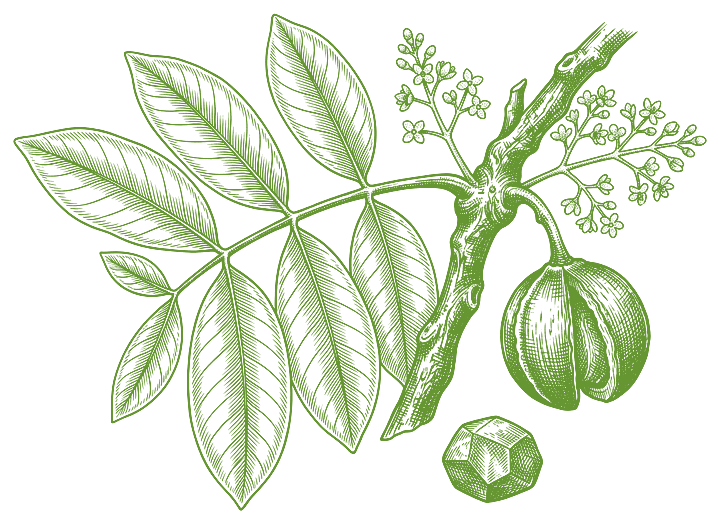
Andiroba is a tall tree with a straight, cylindrical trunk. It usually reaches up to 35 meters and occasionally 55 meters[2, 5], and it grows mostly along rivers and in seasonally flooded or swampy forest[2, 4]. Its native range runs from Central America and the Caribbean through northern South America to the Amazon[1, 2, 5]. The fruit is a round, woody capsule with four lobes that splits open to release its seeds, and it is these seeds that hold the oil[2, 5].
In the Amazon, andiroba oil is still made by hand, mostly by women in riverside communities[3, 4]. In one study in Amazonas state the makers were married women over 35, and young people no longer took part[3]. The seeds are gathered from the ground, boiled in water for a few hours, and then left to rest, usually for about two weeks[3, 4]. The shells are removed and the kernels are kneaded by hand into a paste, which is spread on a sloping board, often in the shade[3, 4]. Every day the paste is kneaded again, and over the following weeks the oil slowly drips out and is collected[3, 4]. It is slow work: the same Amazonas study found that makers needed anywhere from 2 to 11 kilograms of seed for each liter of oil[3].
The oil and its leftovers have many household uses. Andiroba oil has long been burned in lamps[2, 3, 5]; the leftover paste goes into soap and candles[2, 3, 4]; and the burned shells give a smoke that keeps insects away[3, 4]. Today andiroba oil is also sought after by the cosmetics industry, and it is sold beyond Brazil[3, 4]. The tree's timber, crabwood, is valued for furniture, cabinetwork and flooring[2, 5].
Traditional uses
Clinical studies in people are still few, but andiroba oil has a long and practical place in Amazonian homes[3, 4].
Skin and hair
In the Amazon, andiroba oil is rubbed onto the skin and worked into the hair[3, 5]. Andiroba oil moisturizes and conditions the skin and hair.*
Soap-making
Crude andiroba oil and the paste left over from making it are turned into soap.[2, 3, 4]
Light
The oil is burned in household lamps, and the leftover paste is made into candles.[2, 3, 4]
Plant compounds
Like other seed oils, andiroba oil is made mostly of fats. What sets it apart is a group of plant compounds called limonoids: scientists have isolated many different limonoids from andiroba's seed, flower and fruit oils, and new ones are still being described[6, 7]. One family of them, the andirobin-type limonoids, takes its name from the tree[7].
Precautions
- For use on the skin and hair only; not for use by mouth.
- Try a small amount on the skin first, and keep the oil away from the eyes.
- If you are pregnant or breastfeeding, talk to your healthcare practitioner before use.
Where our andiroba comes from
Our andiroba oil is made from wild-harvested seeds. Every batch is tested for heavy metals, mold, yeast and pathogens.
- Wild-harvested
- South America
- Tested every batch
Raintree products with andiroba

Frequently asked questions
What is andiroba oil?
Andiroba oil is the oil made from the seeds of the andiroba tree, Carapa guianensis, a tall tree of the mahogany family that grows from Central America to the Amazon.
Is andiroba the same as crabwood?
Yes, it is the same tree. "Crabwood" usually means the timber, while "andiroba" is the name most often used for the tree and its seed oil.
How is andiroba oil traditionally made?
The seeds are boiled, left to rest for about two weeks, shelled and kneaded into a paste. The paste is spread on a sloping board and kneaded every day while the oil slowly drips out over several weeks.
Is andiroba related to mahogany?
Yes. Andiroba belongs to the mahogany family, Meliaceae, and its timber is used much like mahogany for furniture and cabinetwork.
Which part of andiroba does Raintree use?
The seed oil. Raintree's andiroba oil is for use on the skin and hair.
Where does andiroba grow?
From Central America and the Caribbean to the Amazon basin, including Brazil, Peru, Colombia, Ecuador, Bolivia, Venezuela and the Guianas, often near rivers.
References
- Royal Botanic Gardens, Kew. Carapa guianensis Aubl. Plants of the World Online. powo.science.kew.org
- Orwa C, Mutua A, Kindt R, Jamnadass R, Anthony S. Carapa guianensis. Agroforestree Database: a tree reference and selection guide, version 4.0. World Agroforestry Centre; 2009. worldagroforestry.org
- Mendonça AP, Ferraz IDK. Óleo de andiroba: processo tradicional da extração, uso e aspectos sociais no estado do Amazonas, Brasil. Acta Amazonica. 2007;37(3):353–364. doi:10.1590/S0044-59672007000300006
- Damasceno DC, de Pina EA, da Silva EAS, de Sousa FF, Silva JB, de Jesus RT. Characterization of andiroba oil production (Carapa guianensis Aubl.) of riverside women communities of Mutuacá Island, Cametá-PA. Revista de Gestão Social e Ambiental. 2024;18(12):e010059. doi:10.24857/rgsa.v18n12-173
- Fern K. Carapa guianensis. Useful Tropical Plants. tropical.theferns.info
- Ninomiya K, Miyazawa S, Ozeki K, Matsuo N, Muraoka O, Kikuchi T, Yamada T, Tanaka R, Morikawa T. Hepatoprotective limonoids from andiroba (Carapa guianensis). International Journal of Molecular Sciences. 2016;17(4):591. doi:10.3390/ijms17040591
- Kikuchi T, Akita K, Koike H, In Y, Yamada T, Tanaka R. Carapanins A–C: new limonoids from andiroba (Carapa guianensis) fruit oil. Organic & Biomolecular Chemistry. 2020;18:9268–9274. doi:10.1039/d0ob01872d
- Dicionário Caldas Aulete Digital. Andiroba. Lexikon Editora Digital. aulete.com.br