

 USD
USD


Did you know?
The word cohosh comes from Eastern Abenaki, a Native American language of the Algonquian family, and "black" refers to the dark color of the rhizome[4, 8, 9, 13].
Its old genus name, Cimicifuga, joins the Latin cimex, "bug", and fugare, "to drive away." The plant was once used to keep insects away, and one of its English names, bugbane, says the same[4, 7, 10, 13].
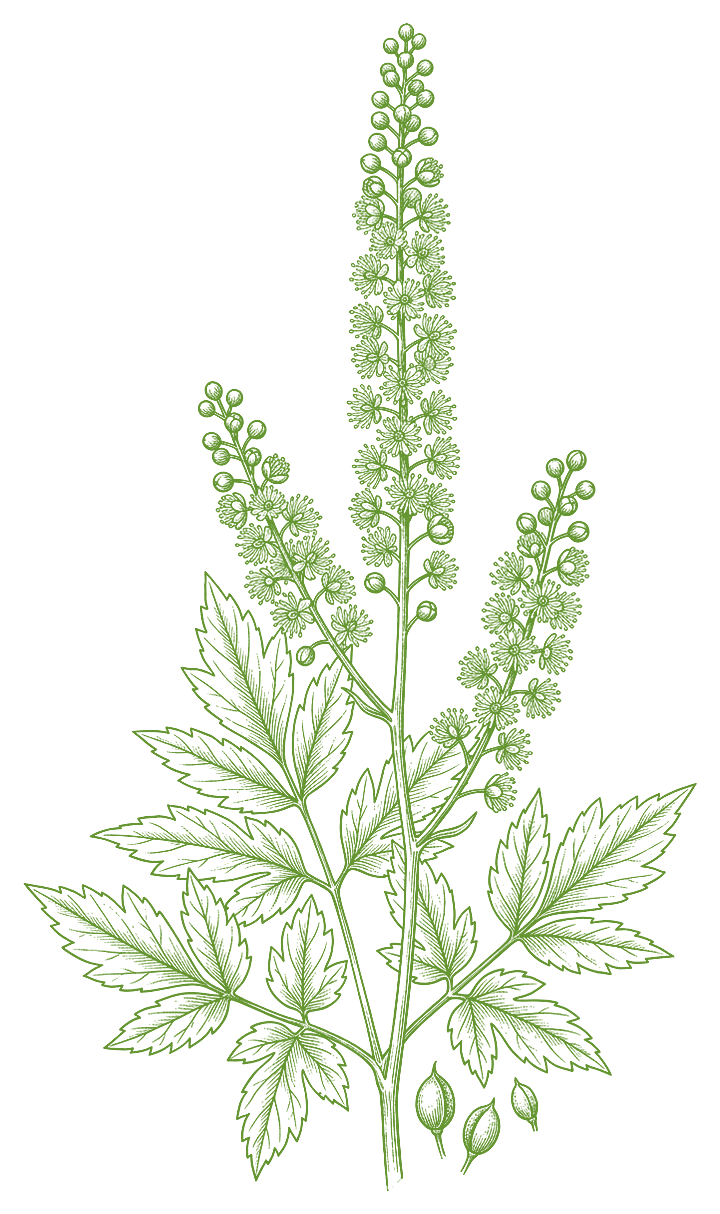
Its tall white flower spikes are made of tiny flowers with no petals, each one a fluffy tuft of stamens[10]. They are showy, but they have an unpleasant smell[5, 10].
Carl Linnaeus named the plant Actaea racemosa in 1753. In 1818 the botanist Thomas Nuttall moved it to Cimicifuga, and botanists have since returned it to Actaea[1, 6].
Black cohosh was one of the ingredients in Lydia Pinkham's Vegetable Compound, an old-time American tonic of the early 1900s[4].
It is a caterpillar food plant of the Appalachian azure butterfly, and of the spring azure too[10].
Origins and history
Black cohosh grows in shady woodlands and along forest edges[4, 10]. From an underground rhizome it sends up large compound leaves[5, 10], and in summer, flowering stems up to about 8 feet (2.5 m) tall, topped with long, slender spires of small white flowers[4, 5, 11]. Its range runs from Ontario and New York south to Georgia and Alabama, and west to Missouri and Arkansas[1, 10, 11].
Native Americans used the root for women's health, and European settlers took it up as a tonic for women too[2, 3, 4]. In the 19th century black cohosh became an important herb of America's Eclectic physicians, who knew it as macrotys[4, 5]. In 1835 the Eclectic physician John King prepared the first resin from its root[5]. Its historical names include black snakeroot, bugbane and rattleweed[2, 3, 5]. Rattleweed comes from the dry seed pods, whose loose seeds rattle in the wind[13], and another name, fairy candles, suits its tall white flower spires[10].
Black cohosh then crossed the Atlantic. In Germany, women have used black cohosh root for more than 70 years[3, 4]. Today European herbal regulators recognize its use by women going through menopause[12].
Traditional uses
Black cohosh has been studied in many clinical trials in women going through menopause[2, 3], and its use for women's health goes back to Native American tradition[2, 3, 6].
Women's health through menopause
This is black cohosh's best-known use today, in North America and in Europe. Black cohosh supports women's health through menopause.*[3, 12]
Women's health through the monthly cycle
Native Americans used the root for women's health through the monthly cycle, and settlers took it as a women's tonic.*[2, 3, 4]
A long European tradition
In Germany, black cohosh root has been part of women's herbal practice for more than 70 years.[3, 4]
Plant compounds
Black cohosh root and rhizome contain triterpene glycosides, such as actein, 23-epi-26-deoxyactein and cimicifugoside[2, 4, 6]. They also contain aromatic acids, including caffeic, isoferulic and fukinolic acids, and resins such as cimicifugin[2, 4, 5].
Precautions
- Not for use during pregnancy or breastfeeding[3, 4, 12].
- Rare cases of liver problems have been reported in people taking black cohosh products[3, 6, 12]. Talk to your healthcare practitioner before use, especially if you have a liver condition. Stop use and contact your healthcare practitioner if you notice unusual tiredness, loss of appetite, dark urine, or yellowing of the skin or eyes[2, 12].
- If you have a hormone-sensitive condition, or take any medication, talk to your healthcare practitioner before use[3, 12].
Where our black cohosh comes from
Our black cohosh is wild-harvested. Every batch is tested for heavy metals, mold, yeast and pathogens.
- Wild-harvested
- South America
- Tested every batch
Raintree products with black cohosh
Black Cohosh is also an ingredient in these Raintree products
Frequently asked questions
What is black cohosh?
Black cohosh is Actaea racemosa, a tall woodland plant of the buttercup family, native to eastern North America. Its root and rhizome have a long tradition in women's health.
Is black cohosh the same as blue cohosh?
No. Blue cohosh is a different plant with different effects, and the two should not be confused. "Cohosh" is a name shared by several North American plants.
Is Actaea racemosa the same as Cimicifuga racemosa?
Yes. Both names refer to the same plant. Cimicifuga racemosa is the older name and is still used on many labels, including ours; botanists now place the plant in the genus Actaea.
Why is black cohosh called bugbane?
Its old genus name, Cimicifuga, comes from the Latin for "bug" and "to drive away," and the plant was once used to keep insects away. Bugbane carries the same idea into English.
Which part of black cohosh is used?
In herbal tradition, the root and rhizome, the plant's underground stem. Black cohosh is one of the herbs in our Menopause Support formula.
Where does black cohosh grow?
It grows in shady woodlands of eastern North America, from Ontario south to Georgia and west to Missouri and Arkansas.
References
- Royal Botanic Gardens, Kew. Plants of the World Online: Actaea racemosa L. powo.science.kew.org
- National Institutes of Health, Office of Dietary Supplements. Black cohosh: fact sheet for health professionals. ods.od.nih.gov
- National Center for Complementary and Integrative Health (NCCIH). Black cohosh. nccih.nih.gov. Updated November 2024.
- Drugs.com. Black cohosh. The Review of Natural Products (professional monograph). drugs.com/npp/black-cohosh.html. Updated November 2025.
- Felter HW, Lloyd JU. Cimicifuga (black cohosh). In: King's American Dispensatory. Cincinnati: Ohio Valley Co.; 1898. Online text: henriettes-herb.com
- LiverTox: Clinical and Research Information on Drug-Induced Liver Injury. Black cohosh. Bethesda (MD): National Institute of Diabetes and Digestive and Kidney Diseases; updated 15 April 2025. ncbi.nlm.nih.gov/books/NBK547990
- GBIF Secretariat. Actaea racemosa L.: vernacular names (GRIN Taxonomy, ITIS, Catalogue of Life, VASCAN, Vermont Checklist). gbif.org
- Merriam-Webster Dictionary. Cohosh. merriam-webster.com
- The American Heritage Dictionary of the English Language. Cohosh. ahdictionary.com
- North Carolina State University Extension. Actaea racemosa (black cohosh). North Carolina Extension Gardener Plant Toolbox. plants.ces.ncsu.edu
- Lady Bird Johnson Wildflower Center, University of Texas at Austin. Actaea racemosa (black baneberry). Native Plant Database. wildflower.org
- European Medicines Agency, Committee on Herbal Medicinal Products. European Union herbal monograph on Cimicifuga racemosa (L.) Nutt., rhizoma. Revision 1. EMA/HMPC/48745/2017. 2018. ema.europa.eu
- Lloyd JU, Lloyd CG. Cimicifuga racemosa. In: Drugs and Medicines of North America. Cincinnati; 1884–1887. Online text: henriettes-herb.com