

 USD
USD


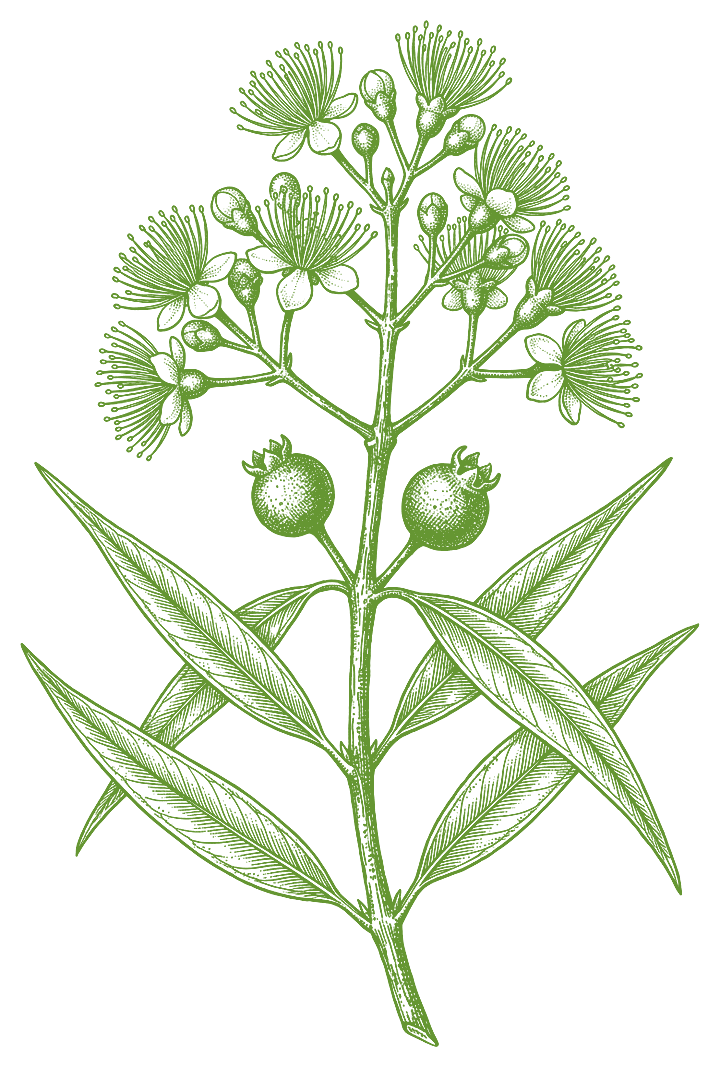
Did you know?
The name mixes two languages. Pedra-ume is Portuguese for alum, the mineral salt, and caá is a Tupi word for plant or herb, so pedra hume caá means roughly "alum plant"[6, 7, 8].
In Brazil, caá on its own can also mean yerba mate, the leaf behind South America's mate tea[6, 8].
Pedra hume caá is not one species. In Brazil the name is shared by several Myrcia shrubs, including Myrcia salicifolia and Myrcia multiflora[4, 5].
Myrcia is a big genus: a 2015 review counts 753 species, 260 of them in Brazil[4].
It belongs to the myrtle family, alongside guava, clove, allspice, eucalyptus and jaboticaba[9], and the Amazon's own camu camu[1].
Like its relatives clove and eucalyptus, it comes from an aromatic group of plants: Myrcia leaves carry fragrant essential oils[4, 9].
Origins and history
Pedra hume caá grows in the wet tropical forests of the Amazon. Kew's Plants of the World Online records it from southeastern Colombia to Peru and northern Brazil, and most recorded specimens come from Brazil and Colombia[1, 2]. It grows as a shrub or tree[1], and like most of the myrtle family it has evergreen leaves dotted with tiny oil glands[4, 9]. De Candolle gave it the name Myrcia salicifolia in 1828, and for a time botanists placed it in a separate genus, as Aulomyrcia salicifolia[1].
The name pedra hume caá is a Brazilian folk name, not a botanical one, and it is not limited to a single plant. A review of the genus lists nine Myrcia species used under this group of names, among them M. salicifolia, M. multiflora, M. uniflora and M. speciosa[4]. The US herb trade's standard naming guide, Herbs of Commerce, lists "pedra hume" for Myrcia multiflora[5]. The words themselves tell a small story about Brazil's two languages. Pedra-ume (spelled pedra hume in the plant's name) is the Portuguese name for alum[6, 7]. Caá comes from Tupi, an Indigenous language of Brazil, where it was a general word for plants and herbs and especially for yerba mate[6, 8].
The leaf is the part people use. In Brazilian folk tradition, the leaves of these Myrcia shrubs, and sometimes the whole plant, are brewed as an infusion[4].
Traditional uses
Clinical studies in people are still few, but pedra hume caá has a long place in Brazilian folk tradition, where its leaf tea is widely used[4].
Leaf tea
The leaves are traditionally brewed in hot water as an infusion.[4]
Healthy blood sugar
In Brazil, pedra hume caá leaf tea is traditionally taken for healthy glucose metabolism.* It helps maintain healthy blood sugar levels already within the normal range.*[4]
One name, several shrubs
The tea tradition belongs to several Myrcia species sold under the same name[4, 5]. Raintree's pedra hume caá is labeled as Myrcia salicifolia.
Plant compounds
The Myrcia species sold as pedra hume caá have been studied mainly for their flavonoids. Their leaves contain flavonoid glycosides such as myricitrin and mearnsitrin, plant compounds in which a flavonoid is joined to a sugar[4]. Myrcia multiflora has also yielded quercitrin, guaijaverin and desmanthin-1, and compounds called myrciacitrins and myrciaphenones[4]. Like the rest of the myrtle family, Myrcia is also an aromatic genus: its leaves carry fragrant essential oils[4, 9].
Precautions
- Not for use during pregnancy or breastfeeding.
- If you take medication for blood sugar, talk to your healthcare practitioner before use.
- If you have a thyroid condition or take thyroid medication, talk to your healthcare practitioner before use.
Where our pedra hume caá comes from
Our pedra hume caá leaf is wild-harvested. Every batch is tested for heavy metals, mold, yeast and pathogens.
- Wild-harvested
- South America
- Tested every batch
Raintree products with pedra hume caá
Pedra Hume Caá is also an ingredient in these Raintree products
Frequently asked questions
What does pedra hume caá mean?
It joins Portuguese and Tupi. Pedra-ume is Portuguese for alum, a mineral salt, and caá is a Tupi word for plant or herb, so the name means roughly "alum plant."
Is pedra hume caá one plant?
Not exactly. In Brazil the name is shared by several closely related Myrcia shrubs, including Myrcia salicifolia and Myrcia multiflora. Raintree's pedra hume caá is labeled as Myrcia salicifolia.
Which part of pedra hume caá does Raintree use?
The leaf, dried and powdered.
How is pedra hume caá traditionally prepared?
The leaves are brewed in hot water as an infusion, or tea.
Where does pedra hume caá grow?
Myrcia salicifolia grows in the wet tropical forests of the Amazon, from southeastern Colombia to Peru and northern Brazil.
Is pedra hume caá related to camu camu?
Yes. Both belong to the myrtle family, Myrtaceae, which also includes guava, clove and eucalyptus.
References
- Royal Botanic Gardens, Kew. Plants of the World Online: Myrcia salicifolia DC.; Myrcia multiflora (Lam.) DC.; Myrciaria dubia (Kunth) McVaugh. powo.science.kew.org
- GBIF Secretariat. Myrcia salicifolia DC.: GBIF Backbone Taxonomy and occurrence records by country. gbif.org
- International Plant Names Index (IPNI). Author record: Candolle, Augustin Pyramus de (DC.), 1778–1841. ipni.org
- Cascaes MM, Guilhon GMSP, Andrade EHA, Zoghbi MGB, Santos LS. Constituents and pharmacological activities of Myrcia (Myrtaceae): a review of an aromatic and medicinal group of plants. International Journal of Molecular Sciences. 2015;16(10):23881–23904. doi:10.3390/ijms161023881
- Royal Botanic Gardens, Kew. Medicinal Plant Names Services: Myrcia multiflora (Lam.) DC. (names and sources, including McGuffin et al., Herbs of Commerce, 2000; US FDA Substance Registration System; GRIN-Global). mpns.science.kew.org
- Dicionário Priberam da Língua Portuguesa. Pedra-ume; caá. dicionario.priberam.org
- Infopédia, Dicionário Porto Editora. Pedra-ume. infopedia.pt
- Aulete Digital, Dicionário Contemporâneo da Língua Portuguesa. Caá. aulete.com.br
- Encyclopaedia Britannica. Myrtaceae. britannica.com