

 USD
USD


Did you know?
Stevia's Guaraní name, ka'a he'ẽ, means "sweet herb." Reference books also spell it caa-ehe or ca-a-e[8, 9].
Bertoni first named the plant Eupatorium rebaudianum in 1899, then moved it to the genus Stevia in 1905[1, 4].
In 1931 two French chemists, M. Bridel and R. Lavieille, isolated the compounds behind the leaf's sweetness[4].
Stevioside, the most plentiful sweet compound in the leaf, is about 300 times sweeter than sugar, weight for weight[2, 3, 4].
Japan was the first country to produce purified stevia extracts commercially, in the early 1970s[2, 3].
Stevia belongs to the daisy family, the same family as sunflowers, marigolds and ragweed[2, 5].
Origins and history
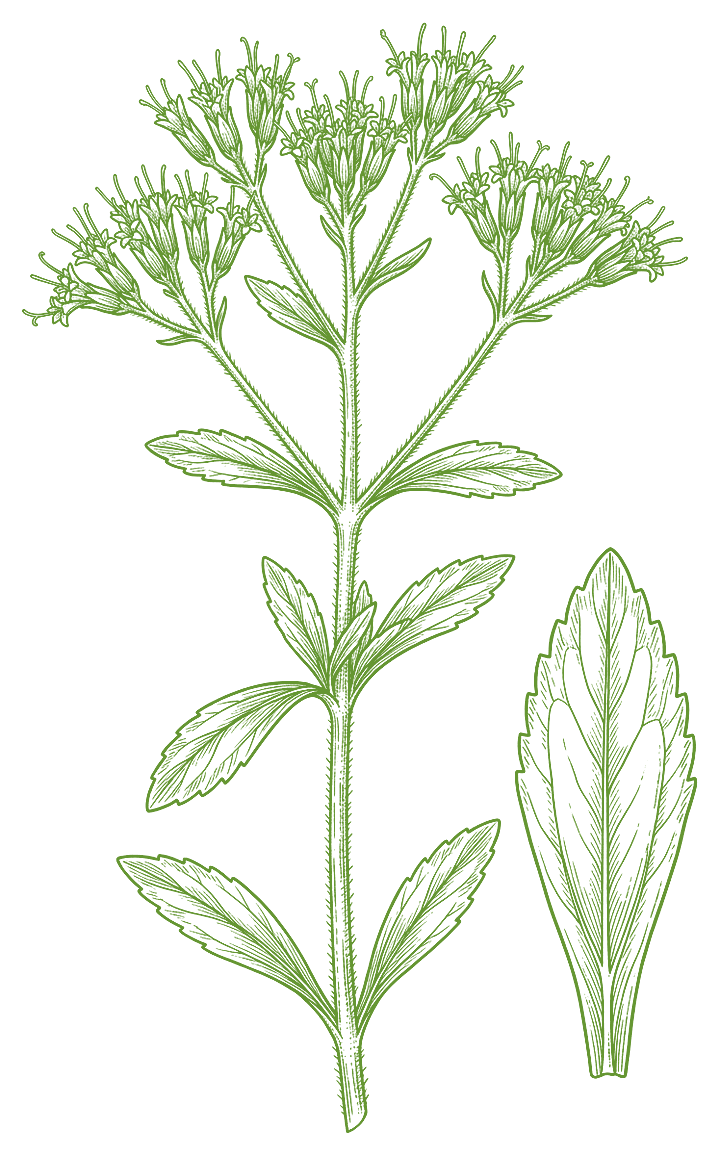
Stevia is a tender perennial herb, about 1 to 3 feet (30 centimeters to 1 meter) tall, with small, oblong, aromatic leaves set in opposite pairs along the stems and clusters of small white flowers[2, 4]. It grows wild in Paraguay and in the neighboring Brazilian states of Mato Grosso do Sul and Minas Gerais[1, 5].
Long before botanists knew of it, stevia was known to the Guaraní people of Paraguay. They added the dried leaves to yerba mate and other bitter drinks, and they have done so for centuries[2, 3, 4]. Their name for it, ka'a he'ẽ, simply means "sweet herb"[8, 9]. Western science learned of the plant from Moisés Santiago Bertoni, a Swiss-born botanist who had made his home in Paraguay. He described it in 1899 as Eupatorium rebaudianum, and in 1905 he moved it to the genus Stevia, giving it the name used today[1, 2, 4].
The chemistry followed. In 1931 the French chemists M. Bridel and R. Lavieille isolated the leaf's sweet compounds, the steviol glycosides[4]. In the early 1970s Japan became the first country to produce purified stevia extracts commercially[2, 3], and the European Union approved purified steviol glycosides for use in food in 2011[2, 3]. Stevia is now grown as a crop far beyond South America, from Central America to China[4].
Traditional uses
Stevia's traditional use is simple, and its sweet compounds have been reviewed in detail by food-safety authorities in the US and Europe[2, 3, 6].
Added to yerba mate
For centuries, Guaraní people in Paraguay have added dried stevia leaves to yerba mate and other bitter teas.[2, 3, 4]
Whole leaf, not an extract
In Guaraní tradition the whole dried leaf is used. Purified stevia extracts are a modern development, first produced commercially in Japan in the early 1970s.[2, 3]
Steviol glycosides
Stevia leaf naturally contains steviol glycosides, the plant compounds responsible for its sweet taste.[3, 6]
Plant compounds
Stevia's sweet taste comes from steviol glycosides, a family of plant compounds built on a core called steviol that carries one or more sugar units[3]. The most abundant is stevioside, typically about 9 percent of the dried leaf[3] and reported at anywhere from 6 to 18 percent[4]; rebaudioside A comes next[3]. The leaf also contains smaller amounts of related glycosides, such as rebaudiosides C, D and E, dulcoside A and steviolbioside[3, 6]. Stevioside is about 300 times sweeter than sugar[2, 3, 4], and the FDA describes high-purity steviol glycosides as 200 to 400 times sweeter than table sugar[6].
Precautions
Where our stevia comes from
Our stevia leaf comes from cultivated plants. Every batch is tested for heavy metals, mold, yeast and pathogens.
- Wild-harvested
- South America
- Tested every batch
Raintree products with stevia
Stevia is also an ingredient in these Raintree products
Frequently asked questions
What does stevia's Guaraní name mean?
Stevia's Guaraní name, ka'a he'ẽ, means "sweet herb." The Guaraní people of Paraguay knew the plant for centuries before botanists did.
Is stevia leaf the same as the stevia sold in grocery stores?
No. In the US, stevia products sold for use in food and drink are made from steviol glycosides purified to at least 95 percent, and the FDA has not questioned the conclusion that these are generally recognized as safe (GRAS) for use in food. Whole stevia leaf and crude leaf extracts do not have GRAS status for food use. In the US, whole stevia leaf may be sold as a dietary ingredient in dietary supplements[6, 7].
Which part of stevia does Raintree use?
The whole leaf, dried and powdered. It is not a purified extract.
Why does stevia leaf taste sweet?
The leaf contains steviol glycosides, mainly stevioside and rebaudioside A. Stevioside on its own is about 300 times sweeter than sugar.
Who discovered stevia?
The Guaraní people of Paraguay used it for centuries. The Swiss-born botanist Moisés Santiago Bertoni described it for science in 1899, and gave it its current name, Stevia rebaudiana, in 1905.
Where does stevia grow?
It grows wild in Paraguay and neighboring parts of Brazil. Today it is also grown as a crop in many other countries, from Central America to China.
References
- Royal Botanic Gardens, Kew. Plants of the World Online: Stevia rebaudiana (Bertoni) Bertoni. powo.science.kew.org
- Encyclopaedia Britannica. Stevia (plant). britannica.com
- Orellana-Paucar AM. Steviol glycosides from Stevia rebaudiana: an updated overview of their sweetening activity, pharmacological properties, and safety aspects. Molecules. 2023;28(3):1258. doi:10.3390/molecules28031258
- Drugs.com. Stevia (natural product monograph). drugs.com/npp/stevia.html
- Memorial Sloan Kettering Cancer Center. About Herbs: Stevia. mskcc.org
- US Food and Drug Administration. Aspartame and other sweeteners in food. fda.gov (updated February 2025)
- US Food and Drug Administration. Import Alert 45-06: Detention without physical examination of stevia leaves, crude extracts of stevia leaves and foods containing stevia leaves and/or stevia extracts. accessdata.fda.gov (published September 2026)
- Royal Botanic Gardens, Kew. Medicinal Plant Names Services: Stevia rebaudiana (names and sources, including van Wyk & Wink, Medicinal Plants of the World, 2004; Duke, Phytochemical Database; GRIN-Global; McGuffin et al., Herbs of Commerce, 2000). mpns.science.kew.org
- Gershon L. Stevia's global story. JSTOR Daily. 10 July 2023. daily.jstor.org