

 USD


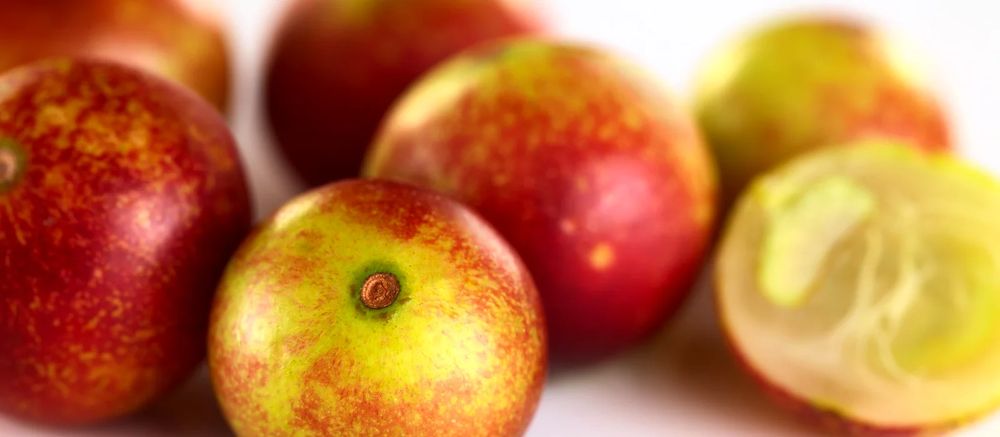
- Camu Camu pulp holds about 1,000 to 6,000 mg of vitamin C per 100 g (Embrapa).
- That is roughly 19 to more than 100 times a raw orange, weight for weight (USDA).
- A powder or capsule has its own figure: the amount printed on its label.
Camu Camu (Myrciaria dubia) is a shrub of the myrtle family from the flooded riverbanks of the Amazon rainforest. Its fruit pulp holds about 1,000 to 6,000 milligrams of vitamin C per 100 grams, according to Embrapa, Brazil's agricultural research agency. A raw orange holds about 53 milligrams, so even the low end is roughly 19 times as much. (Kew, Embrapa harvest guide, USDA)
Camu Camu vitamin C figures always come with two details attached: the part of the plant that was measured, and the weight it was measured in. Keep both in view and the numbers below are easy to compare.
How much Camu Camu vitamin C is in the fruit?
Embrapa's harvest guide gives a range of 1,000 to 6,000 milligrams of vitamin C per 100 grams of pulp. Its earlier booklet on growing the crop records 3,571 to 6,112 milligrams per 100 grams in fruit from eastern Roraima, in the Brazilian Amazon, and notes that pulp can hold 5 grams in every 100 grams. (Embrapa harvest guide, Embrapa plant guide)
The spread is wide because these are measurements of a wild fruit, taken in different places and at different stages of ripeness. Every one of them is a pulp figure, given per 100 grams of fresh pulp. That basis is what makes them comparable with each other, and with other foods.
How does Camu Camu compare with an orange?
The USDA's food composition database lists 53.2 milligrams of vitamin C per 100 grams of raw orange. Set beside Embrapa's range, Camu Camu pulp holds roughly 19 times as much at the low end and more than 100 times as much at the top. (USDA)
Those multiples compare equal weights of fresh fruit. They describe the two fruits, and they work as long as both figures share the same basis.
Where does Camu Camu grow, and how is it gathered?
Camu Camu grows wild in flooded areas along the rivers and lakes of the Amazon, always in full sun. Most of the fruit sold comes from these wild stands, where it is gathered from canoes in the flood season, when the rivers are high. In Brazil the plant also goes by Caçari, Araçá d'Água and Camocamo. (Embrapa plant guide)
The shrub has simple leaves in opposite pairs and small flowers with white petals 3 to 4 millimeters long. Its thin skin turns from green to purple as the fruit ripens. That skin is delicate, so Embrapa advises collecting in shallow containers: piled deep, the fruit at the bottom gets crushed. (Embrapa plant guide, Embrapa harvest guide)
Raintree's Camu Camu is wild-harvested.
How is Camu Camu used in food and drinks?
The fruit is sour, and Embrapa's harvest guide says it is mostly eaten processed, as juices, sweets and dried fruit. Its plant guide lists what the pulp becomes: refreshing drinks, ice cream, wine, liqueur, jelly, sweets and cocktails, with the juice and ice cream made and eaten in the traditional way. (Embrapa harvest guide, Embrapa plant guide)
Did you know? Embrapa notes that Camu Camu pulp can hold 5 grams of vitamin C in every 100 grams, which is 50,000 parts per million. (Embrapa plant guide)
Does Camu Camu powder hold the same vitamin C as the pulp?
A powder is pulp with the water taken out, so the same weight holds more of everything else, vitamin C included. How the powder is made matters too. Embrapa has described spray drying Camu Camu pulp with gum arabic as a carrier; in that work the starting pulp measured 1,603 milligrams of vitamin C per 100 grams. (Embrapa processing bulletin)
That is one documented food-processing method. A powder made that way contains a carrier as well as fruit, and its ingredient list says so. The NIH Office of Dietary Supplements adds that prolonged storage and cooking can reduce the vitamin C in foods. (NIH vitamin C fact sheet)
So for any powder or capsule, the vitamin C figure to use is the one measured for that product and printed on its label.
How do you read a Camu Camu supplement label?
Start with the ingredient line. US rules require a supplement label to identify the part of the plant used, and botanicals are listed by their standard common names, with the Latin name where needed. The Supplement Facts panel then lists each dietary ingredient with its amount per serving. (FDA labeling guidance, FDA supplement guidance)
Two kinds of milligram figure can appear. A weight beside Camu Camu is the amount of fruit in a serving. A weight beside vitamin C, usually with a percentage Daily Value, is the amount of the nutrient itself, measured for that product. The Daily Value for vitamin C on US labels is 90 milligrams. (FDA Daily Value guidance)
Our capsules hold only the herbs on the label, in a vegan capsule made of hypromellose, a plant cellulose, with no fillers, binders or flow agents. See the Camu Camu Capsules page for the current label and how to take them.

Precautions
Read the full Camu Camu herb guide for the plant's history and names, or browse our herb guide index to meet the other rainforest herbs in our products.
Frequently asked questions
Is Camu Camu the same as vitamin C?
No. Camu Camu is a fruit-bearing shrub, Myrciaria dubia, and vitamin C is one of the nutrients in its fruit pulp. On a supplement label the two appear separately: the fruit as an ingredient with its own weight, and vitamin C as a nutrient with its own amount and percentage Daily Value.
How much more vitamin C does Camu Camu have than an orange?
By weight, roughly 19 to more than 100 times as much. Embrapa gives 1,000 to 6,000 milligrams per 100 grams of Camu Camu pulp, and the USDA lists 53.2 milligrams per 100 grams of raw orange. Both figures are for fresh fruit, weighed the same way, so the comparison holds.
Are Camu Camu and Camocamo the same plant?
Yes. Embrapa records Camocamo as another name for Camu Camu, alongside Caçari and Araçá d'Água in Brazil. The Latin name, Myrciaria dubia, is the reliable check. When two product descriptions use different common names, matching Latin names confirm that both describe the same species.
Does drying Camu Camu change its vitamin C?
Yes, the figure changes. Drying removes water, so a gram of powder holds more vitamin C than a gram of fresh pulp, while long storage can lower it. Some powders also include a carrier such as gum arabic. For any dried product, use the vitamin C amount measured for that product and shown on its label.
What does a percentage Daily Value for vitamin C mean?
It shows how much of the 90 milligram Daily Value one serving provides. The percentage describes the nutrient in a serving. It says nothing about how much Camu Camu is in a capsule, and it is separate from the vitamin C content of the fruit itself, which is measured per 100 grams of pulp.
Sources
- Royal Botanic Gardens, Kew. Plants of the World Online: Myrciaria dubia (Kunth) McVaugh, accepted name and native range.
- Durigan MFB, Guimarães PVP, Grigio ML. Boas práticas na colheita e pós-colheita de camu-camu. Embrapa, December 2019. Pulp vitamin C range (1,000 to 6,000 mg per 100 g), skin color, shallow containers; the fruit mostly eaten processed, as juices, sweets and dried fruit.
- Nascimento WMO, Carvalho JEU. A cultura do camu-camu. Coleção Plantar 71. Embrapa Amazônia Oriental, 2012. Names, habitat, full sun, canoe harvest, leaves and flowers, food uses, Roraima vitamin C figures, 5 g per 100 g.
- US Department of Agriculture. FoodData Central, SR Legacy: Oranges, raw, all commercial varieties (FDC ID 169097), vitamin C 53.2 mg.
- Cornejo FEP, Silva NK, Matta VM, Freitas SP. Obtenção de camu-camu em pó com elevado teor de compostos bioativos. Comunicado Técnico 176, Embrapa Agroindústria de Alimentos, 2010. Spray drying with gum arabic; pulp at 1,603 mg per 100 g.
- NIH Office of Dietary Supplements. Vitamin C: Fact Sheet for Consumers. Storage and cooking; telling your health care providers about supplements.
- US Food and Drug Administration. Small Entity Compliance Guide: Statement of Identity, Nutrition Labeling and Ingredient Labeling of Dietary Supplements. Plant part and botanical names on labels.
- US Food and Drug Administration. FDA 101: Dietary Supplements. Supplement Facts contents; talk with a health care professional; interactions with medications.
- US Food and Drug Administration. Daily Value on the Nutrition and Supplement Facts Labels. Vitamin C Daily Value, 90 mg.