

 USD
USD


Did you know?
Amor seco is Spanish for "dry love". Spanish speakers give the name to several herbs whose prickly fruits catch on hair and clothing[4].
Tiny hooked hairs on its seed pods let them cling to clothing, skin, fur and even feathers, so passing people and animals carry the seeds to new ground[3].
Brazilians have several "love" names for it, among them amor-do-campo ("love of the field"), amor-de-brejo ("marsh love"), amor-rasteiro ("creeping love") and amor-de-velho ("old man's love")[2].
Its roots help fix nitrogen from the air, enriching the soil, and it has been planted as a cover crop and green manure in tropical plantations[3].
Botanists have renamed it twice. First described as Hedysarum adscendens, it was moved to Desmodium in 1825 and then, in 2018, to Grona[1, 2, 3].
In Ecuador it shares the name hierba del infante with a close relative, Desmodium molliculum[5].
Origins and history
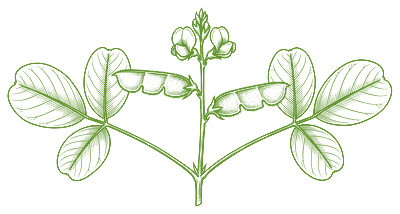
Amor seco is a perennial herb with much-branched stems that creep along the ground or rise at the tips, growing up to about 3 feet (1 m) tall. Older stems can turn somewhat woody, and they often root where they touch the soil[3]. It likes humid, shady places such as stream banks and damp forest, and it also grows on the banks of rice fields; in many parts of the tropics it has become a weed[3].
The plant was first described by the botanist Olof Swartz as Hedysarum adscendens, and Augustin Pyramus de Candolle moved it to Desmodium in 1825, the name still in wide use today[1, 2, 5]. In 2018 H. Ohashi and K. Ohashi placed it in the genus Grona, which is now its accepted name[1, 2, 3].
In Africa the herb is widely used. In Benin the leafy stems of amor seco and its relatives are boiled into a tea, and in Congo it is prepared as a water extract[6, 7]. It is also used in France and Belgium, and as far away as China[5]. In Brazil it has a whole family of local names, from pega-pega and carrapicho, names given to plants whose seeds stick to clothing, to its many names built on amor[2, 8].
Traditional uses
Clinical studies of amor seco in people are still few, but its traditional use is rich and spans two continents.
A leaf-and-stem tea
In Benin the leafy stems are boiled in water and the tea is drunk, and elsewhere the plant is taken as a juice or tea.[6, 7]
Respiratory health
Across Africa, amor seco is a well-known traditional herb for the chest and easy breathing, and it is used the same way in Brazil and Europe. Amor seco supports respiratory health.*[5, 7]
Liver function
In Africa and Brazil it is a traditional herb for the liver, and it is valued in France and Belgium too. Amor seco supports healthy liver function.*[5]
Antioxidant compounds
The leaves provide naturally occurring antioxidant compounds.*[5, 7]
Plant compounds
Amor seco leaves contain naturally occurring flavonoids and other phenolic compounds, including anthocyanins and tannins, and they have been analyzed in detail for their antioxidant compounds[5, 7]. Terpenes and alkaloids have also been reported in the plant[5].
Precautions
- Not for use during pregnancy or breastfeeding.
- If you take medication or have a health condition, talk to your healthcare practitioner before use.
Where our amor seco comes from

Our amor seco whole herb (root, leaf and stem) is wild-harvested in the Brazilian Amazon. Every batch is tested for heavy metals, mold, yeast and pathogens.
- Wild-harvested
- South America
- Tested every batch
Raintree products with amor seco
Amor seco is also an ingredient in these Raintree products

Frequently asked questions
What does amor seco mean?
Amor seco is Spanish for "dry love". It is a name given to several herbs whose prickly fruits catch on hair and clothing, which is exactly what amor seco's small, clinging pods do.
What is amor seco called in English?
Its English names are tick-trefoil and tick-clover. Botanists know it as Desmodium adscendens, or by its newer accepted name, Grona adscendens.
Why does amor seco stick to clothes?
Its small seed pods are covered in tiny hooked hairs. They catch on clothing, skin, fur and feathers, which helps the plant spread its seeds.
Where does amor seco grow?
It grows wild in tropical America, from southern Mexico and the Caribbean through Central America to Peru and Brazil, and across tropical Africa. It favors humid, shady places such as stream banks and damp forest, and it often grows as a weed.
How is amor seco traditionally prepared?
As a tea or decoction. In West Africa the leafy stems are boiled in water, strained and drunk; elsewhere the plant is also taken as a juice.
Which part of amor seco does Raintree use?
We use the whole herb (root, leaf and stem), wild-harvested in the Brazilian Amazon.
References
- Royal Botanic Gardens, Kew. Plants of the World Online: Grona adscendens (Sw.) H.Ohashi & K.Ohashi (synonym Desmodium adscendens (Sw.) DC.). powo.science.kew.org
- GBIF Secretariat. Desmodium adscendens (Sw.) DC., Prodr. 2: 332 (1825) (accepted as Grona adscendens): taxonomy and vernacular names (GRIN Taxonomy; Flora e Funga do Brasil, Lista Oficial). GBIF Backbone Taxonomy. gbif.org
- Fern K. Grona adscendens. Useful Tropical Plants Database. tropical.theferns.info
- Real Academia Española. Amor seco (entry "amor"). Diccionario de la lengua española. dle.rae.es
- Sarmiento-Pacurucu J, Santos-Ordóñez E, León-Tamariz F, Villao-Uzho L, Calle-Lopez J, Peñaherrera E. DNA barcode analysis and antioxidant activity of Desmodium molliculum and Desmodium adscendens. Research Square (preprint). 2024. doi:10.21203/rs.3.rs-3921753/v1
- Bade F, Maliki R, Allagbe M, et al. Ethnobotanical survey of three species of Desmodium genus (Desmodium ramosissimum, Desmodium gangeticum and Desmodium adscendens) used in traditional medicine, Benin. International Journal of Sciences. 2018;7:26–33. doi:10.18483/ijSci.1860
- Muanda FN, Bouayed J, Djilani A, Yao C, Soulimani R, Dicko A. Chemical composition and cellular evaluation of the antioxidant activity of Desmodium adscendens leaves. Evidence-Based Complementary and Alternative Medicine. 2011;2011:620862. doi:10.1155/2011/620862
- Dicionário Priberam da Língua Portuguesa. Pega-pega. dicionario.priberam.org