

 USD
USD


Did you know?
Its hollow stems are divided into chambers that often house Azteca ants. The ants patrol the leaves against plant-eating insects and clear away climbing vines, and the tree gives them shelter and food in return[2, 3]. On the Caribbean islands the partnership fades, and the trees of Puerto Rico have neither the ants nor the ant food[2].
The ants' food grows on a small pad at the base of each leaf stalk: tiny food bodies called Müllerian bodies, packed with glycogen, a storage sugar far better known from animals than from plants[2, 3, 6].
Sloths are regular diners. Cecropia leaves are a favorite of three-toed sloths, and the brown-throated three-toed sloth feeds mainly on cecropia trees[3, 5]. In Brazil one of its names is árvore-da-preguiça, the "sloth tree"[12].
The names trumpet tree, trumpet wood and pop-a-gun come from the hollow branches, which can be cut into blow tubes and trumpets[4, 7]. Along the Uaupés River in the northwest Amazon, the stems were made into drums[4].
Its rough leaves have been used as sandpaper, for example to smooth calabash shells[4].
A mature tree can produce about a million seeds a year, carried off by the birds and bats that feast on its long, finger-like fruit[2, 3, 4].
Origins and history
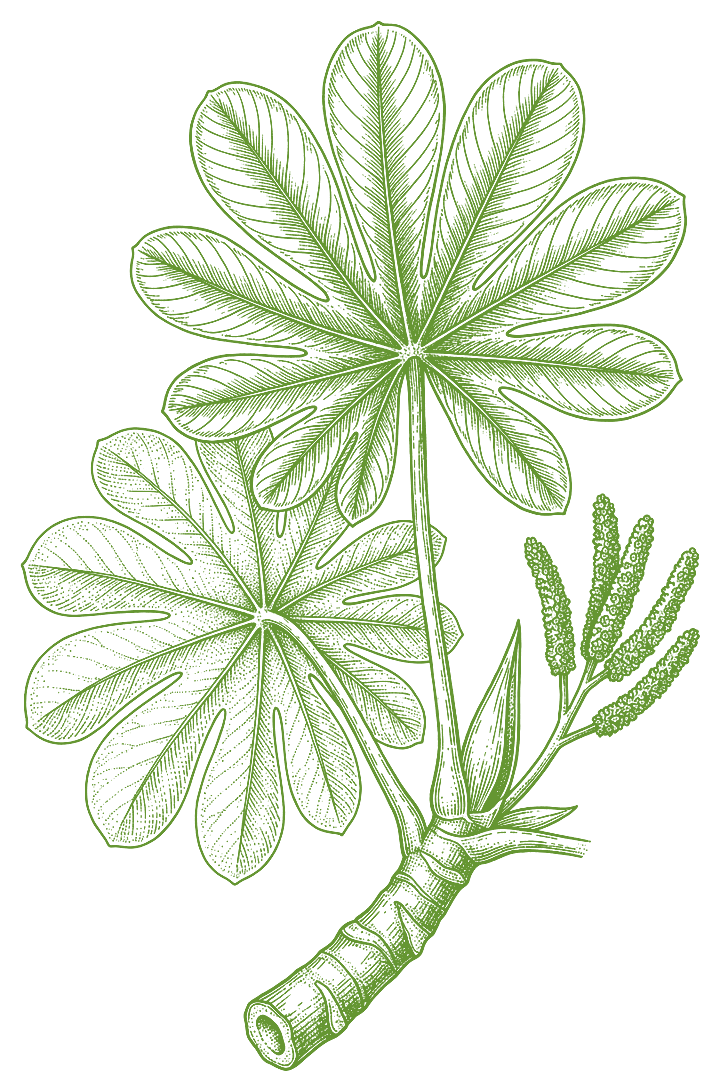
Embaúba is a tree of new beginnings. When a gap opens in the forest, where a tree has fallen, a slope has slipped or a road has been cut, it is often among the first trees to grow[2, 3]. It grows fast, with seedlings shooting up as much as 7 feet (2.1 m) in their first year; it lives about 30 years and usually reaches about 45 feet (14 m)[2, 3]. Stilt roots brace the base of its slender trunk, and the crown is an open umbrella of huge, deeply lobed leaves, 12 to 20 inches (30–50 cm) across, with a silvery-white underside[2, 4, 7, 13]. Linnaeus gave the species its scientific name[1]. The genus name recalls Cecrops, the mythical first king of Athens[13], and peltata means "shield-shaped": the long leaf stalk joins the blade near its middle, like the grip on the back of a shield[2, 4].
Across its range the tree has many names. It is embaúba or imbaúba in Brazilian Portuguese, from the Tupi amba'iwa; guarumo or yagrumo in Spanish; and bois canon in the French Caribbean[7, 8, 12]. People have found a use for almost every part of it. The wood is very light, only slightly heavier than balsa, and has been made into boxes, crates and matches; in Puerto Rico it has gone into the cuatro, the island's guitar-like instrument[2, 4]. The tough fiber of the inner bark has been twisted into rope[4]. The long, finger-shaped fruit has sweet, jelly-like flesh and can be eaten raw, and the young buds are occasionally cooked as a green[4]. The fruit also feeds a crowd of birds and bats, and the tiny seeds pass through them unharmed[2].
Traditional uses
Clinical studies of embaúba in people are still few, but its traditional use is rich: across its range, the leaf has long been brewed as a tea.
A leaf tea
The leaves are steeped or simmered in water and drunk as a tea, a use recorded in many parts of the tree's range.[4]
Respiratory health
Embaúba leaf is a traditional herb for the lungs and breathing, and in Brazil, where several cecropias share the name embaúba, their leaves are popular for the same purpose. Embaúba supports respiratory health.*[4, 9, 11]
Heart and circulation
The leaf tea has traditionally been taken to support the heart. Embaúba supports cardiovascular health.*[2, 4]
Plant compounds
Cecropia leaves contain naturally occurring phenolic compounds. Studies of several cecropias, including close relatives of embaúba, find the leaves especially rich in chlorogenic acid and in flavones bound to sugar molecules (C-glycosyl flavones), such as orientin and isoorientin[9, 10, 11]. The ant food bodies at the base of the leaf stalks store glycogen[2, 6].
Precautions
- Not for use during pregnancy or breastfeeding.
- If you take medication, especially for blood pressure or blood sugar, talk to your healthcare practitioner before use.
Where our embaúba comes from
Our embaúba leaf is wild-harvested. Every batch is tested for heavy metals, mold, yeast and pathogens.
- Wild-harvested
- South America
- Tested every batch
Raintree products with embaúba

Embaúba is also an ingredient in these Raintree products
Frequently asked questions
What is embaúba in English?
Embaúba is the trumpet tree, Cecropia peltata, also called trumpet wood or pumpwood. In Spanish it is guarumo or yagrumo.
Why do ants live in embaúba trees?
The hollow stems give Azteca ants a home, and the tree feeds them with glycogen-rich food bodies at the base of its leaf stalks. In return, the ants guard the leaves from plant-eating insects and keep climbing vines off the tree.
Do sloths eat embaúba leaves?
Yes. Cecropia leaves are a favorite food of three-toed sloths, and the brown-throated three-toed sloth feeds mainly on cecropia trees.
Which part of embaúba does Raintree use?
We use the leaf, which is wild-harvested.
Where does embaúba grow?
Embaúba is native from Mexico, Central America and the Caribbean to Colombia, Venezuela, the Guianas and northern Brazil. It springs up in forest gaps, clearings and along roadsides.
Is embaúba the same as cecropia?
Yes. Embaúba is a cecropia, one of several dozen tropical American trees in the genus Cecropia. Raintree's embaúba is Cecropia peltata, the trumpet tree.
References
- Royal Botanic Gardens, Kew. Plants of the World Online: Cecropia peltata L. powo.science.kew.org
- Silander SR, Lugo AE. Cecropia peltata L., yagrumo hembra, trumpet-tree. In: Burns RM, Honkala BH, tech. coords. Silvics of North America. Vol. 2, Hardwoods. Agriculture Handbook 654. Washington, DC: USDA Forest Service; 1990. srs.fs.usda.gov
- Encyclopaedia Britannica. Cecropia. britannica.com
- Fern K. Cecropia peltata. Useful Tropical Plants Database. tropical.theferns.info
- Jung H-J. Bradypus variegatus, brown-throated three-toed sloth. Animal Diversity Web, University of Michigan Museum of Zoology; 2011. animaldiversity.org
- Rickson FR. Glycogen plastids in Müllerian body cells of Cecropia peltata, a higher green plant. Science. 1971;173(3994):344–347. doi:10.1126/science.173.3994.344
- IUCN SSC Invasive Species Specialist Group. Cecropia peltata. Global Invasive Species Database. iucngisd.org
- GBIF Secretariat. Cecropia peltata L.: vernacular names (Catalogue of Life, GRIN Taxonomy, TAXREF). GBIF Backbone Taxonomy. gbif.org
- da Silva Mathias M, Rodrigues de Oliveira R. Differentiation of the phenolic chemical profiles of Cecropia pachystachya and Cecropia hololeuca. Phytochemical Analysis. 2019;30(1):73–82. doi:10.1002/pca.2791
- Rivera-Mondragón A, Peeters L, Van der Auwera A, et al. Simulated gastrointestinal biotransformation of chlorogenic acid, flavonoids, flavonolignans and triterpenoid saponins in Cecropia obtusifolia leaf extract. Planta Medica. 2021;87(5):404–416. doi:10.1055/a-1258-4383
- Aragão DM, Guarize L, Lanini J, da Costa JC, Garcia RM, Scio E. Hypoglycemic effects of Cecropia pachystachya in normal and alloxan-induced diabetic rats. Journal of Ethnopharmacology. 2010;128(3):629–633. doi:10.1016/j.jep.2010.01.008
- Priberam Dicionário da Língua Portuguesa. Embaúba. dicionario.priberam.org
- Merriam-Webster Dictionary. Cecropia. merriam-webster.com