

 USD
USD


Did you know?
It is named for the hour. The flowers open in the late afternoon or at dusk, around four o'clock, and close again by the next morning[3, 4, 5].
One plant can carry flowers of several colors at the same time, and a single flower can be streaked or splashed with a second color[4, 5, 7].
Around the world its names keep time: a las cuatro ("at four") in the Philippines, buenas tardes ("good afternoon") in Spanish and boa-noite ("good night") in Brazil[5, 8].
In Japan it is oshiroi-bana, the "face-powder flower"[8, 15]. Its seeds were pounded into a cosmetic powder in Japan, China and Malaya[5, 6].
Cross a red-flowered four o'clock with a white one and the offspring bloom pink; cross those pinks and red, pink and white flowers all return. It is a textbook example of incomplete dominance[12].
Its flowers yield an edible crimson dye that has been used to color cakes and jellies[5, 6].
Origins and history
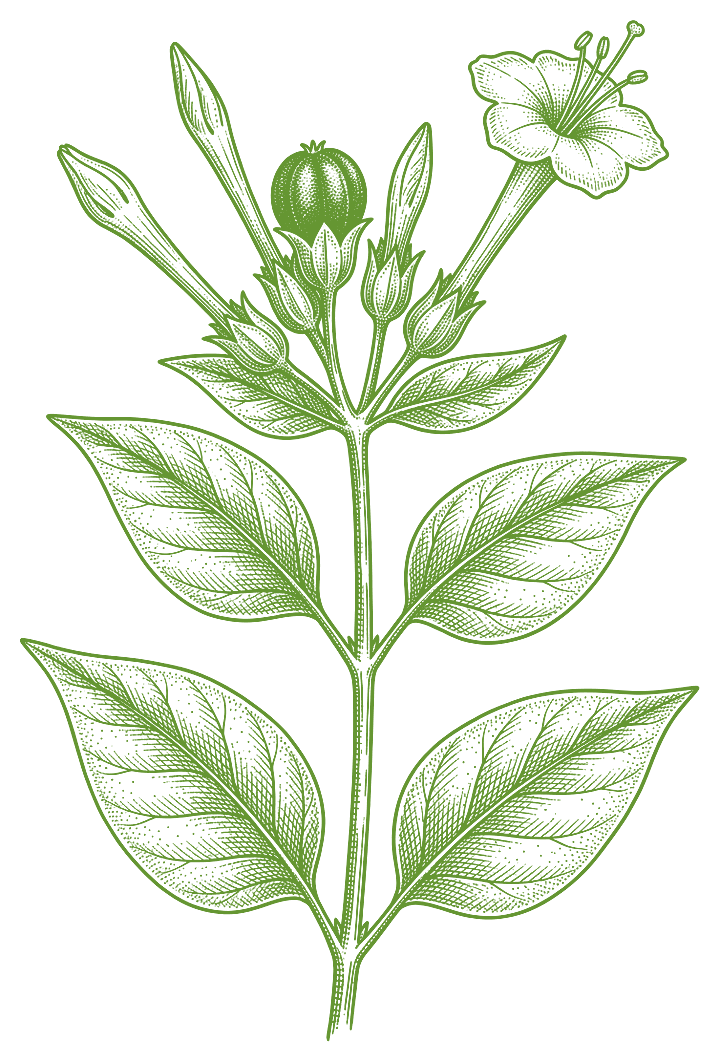
The four o'clock is native to Mexico and Central America, south to Nicaragua[1, 3, 7]. Despite its old English name, marvel of Peru, it is not native to Peru, although it now grows wild there, as it does across the tropics and in many warm temperate regions[1, 5]. It grows up to about a meter (3 ft) tall from a large, potato-like tuberous root[3, 4]. The flowers come in white, yellow, pink, red and purple, open as the day cools and scent the evening air with a sweet fragrance that draws moths[3, 4, 6].
Carl Linnaeus gave the plant its botanical name in 1753[1, 2]. Mirabilis is Latin for "wonderful"[3, 9], and jalapa refers to the town of Jalapa (Xalapa) in Veracruz, Mexico[3]. The plant's other names are just as admiring: marvel of Peru and beauty of the night in English, maravilla ("marvel") and dondiego de noche ("Don Diego of the night") in Spanish, and belle de nuit in French[4, 5, 8]. The Spanish brought it from Mexico to the Philippines, where it now grows throughout settled areas, both in gardens and on its own[5].
The four o'clock also has a place in the history of science. In 1870 Gregor Mendel wrote to the botanist Carl Nägeli about pollinating four o'clock flowers with a single grain of pollen. The 18 seeds he raised grew into plants no different from self-pollinated ones, which showed that one pollen grain is enough to fertilize an egg cell[14]. The German botanist Carl Correns, one of the scientists who rediscovered Mendel's laws of heredity in 1900, studied four o'clocks whose leaves were variegated green and white. In 1909 he showed that their leaf color passed down through the mother plant only, following none of Mendel's rules. It was the first conclusive example of inheritance carried in the cytoplasm of the cell rather than in its nucleus[10, 11].
Traditional uses
Clinical studies of clavillia in people are still few, but the plant has a long folk history as a garden flower, a food, a cosmetic and part of traditional herbal practice.
An evening garden flower
Grown for its colorful, fragrant flowers, which open as the day cools.[3, 4]
A leafy vegetable
Face powder
In Japan, China and Malaya the seeds were ground into a cosmetic powder.[5, 6]
Digestive comfort
In folk tradition, preparations of the plant have been taken for digestive comfort.*[5, 6]
Plant compounds
Clavillia's yellow flower color comes from betaxanthins, a group of betalain pigments. Chemists have isolated indicaxanthin, vulgaxanthin-I and several miraxanthins from the flowers[5, 13]. The roots contain rotenoids, among them a group of compounds called mirabijalones[5].
Precautions
- Our clavillia is the whole plant, dried and powdered, so the root is only a small part of it. Don't eat the seeds or roots of a garden four o'clock on their own, as larger amounts can upset the stomach[3, 6].
- Not for use during pregnancy or breastfeeding.
- If you take medication or have a health condition, talk to your healthcare practitioner before use.
Where our clavillia comes from
Our clavillia is the whole plant, wild-harvested in Peru, where the four o'clock grows wild as an introduced plant. Every batch is tested for heavy metals, mold, yeast and pathogens.
- Wild-harvested
- Peru
- Tested every batch
Raintree products with clavillia

Clavillia is also an ingredient in these Raintree products

Frequently asked questions
What is clavillia in English?
Clavillia, one of its Spanish names, is Mirabilis jalapa, the four o'clock flower, also called marvel of Peru or beauty of the night.
Why is it called the four o'clock flower?
Its flowers stay closed through most of the day and open in the late afternoon or at dusk, around four o'clock. They close again by the next morning.
Can one four o'clock plant have different-colored flowers?
Yes. A single plant can bloom in several colors at once, and one flower can be streaked or splashed with a second color.
Is the four o'clock native to Peru?
No. Despite the name marvel of Peru, it is native to Mexico and Central America. It now grows wild in Peru and throughout the tropics.
Are four o'clock seeds safe to eat?
Not on their own. Eaten in larger amounts, the seeds and roots of a garden four o'clock can upset the stomach. Raintree's clavillia is the whole plant, in which the root is only a small part.
Which part of clavillia does Raintree use?
We use the whole plant, wild-harvested in Peru.
References
- Royal Botanic Gardens, Kew. Plants of the World Online: Mirabilis jalapa L. powo.science.kew.org
- International Plant Names Index (IPNI). Mirabilis jalapa L., Species Plantarum 1: 177 (1753). ipni.org
- NC State Extension Gardener Plant Toolbox. Mirabilis jalapa (four-o'clock). plants.ces.ncsu.edu
- Encyclopaedia Britannica. Four-o'clock. britannica.com
- Stuart GU. A las cuatro, Mirabilis jalapa. Philippine Medicinal Plants. stuartxchange.org
- Plants For A Future. Mirabilis jalapa, marvel of Peru. pfaf.org
- Fern K. Useful Tropical Plants: Mirabilis jalapa. tropical.theferns.info
- GBIF Secretariat. Mirabilis jalapa L.: vernacular names (Catalogue of Life; GRIN Taxonomy; Flora e Funga do Brasil). gbif.org
- Merriam-Webster Dictionary. Mirabilis. merriam-webster.com
- Encyclopaedia Britannica. Carl Erich Correns. britannica.com
- Hagemann R. The foundation of extranuclear inheritance: plastid and mitochondrial genetics. Molecular Genetics and Genomics. 2010;283:199–209. doi:10.1007/s00438-010-0521-z
- Encyclopaedia Britannica. Incomplete dominance. britannica.com
- Piattelli M, Minale L, Nicolaus RA. Pigments of Centrospermae—V. Betaxanthins from Mirabilis jalapa L. Phytochemistry. 1965;4(6):817–823. doi:10.1016/S0031-9422(00)86258-5
- Zhang H, Zhao X, Zhao F, et al. Mendel's controlled pollination experiments in Mirabilis jalapa confirmed his discovery of the gamete theory of inheritance in Pisum. Hereditas. 2022;159:19. doi:10.1186/s41065-022-00232-1
- Jisho.org (JMdict, Electronic Dictionary Research and Development Group). おしろいばな (oshiroibana): four-o'clock plant; 白粉 (oshiroi): white makeup powder, face powder. jisho.org