

 USD
USD


Did you know?
Iporuru's first scientific name was coined by two famous naturalist-explorers, Alexander von Humboldt and the French botanist Aimé Bonpland[1, 2, 6].
In 1824 the plant was moved into the genus Alchornea, the name it still carries today[1, 2].
Iporuru is a riverbank pioneer: in the central Amazon it settles where floods leave fresh sediment, and it tolerates seasonal flooding[3, 4].
It belongs to the spurge family, which also gives us cassava and the poinsettia[1, 5].
Its range spans seven South American countries, from Venezuela in the north to Argentina in the south[1].
In Brazil it is known as oeirana; in Peru, iporuru or ipururo[2, 7, 8].
Origins and history
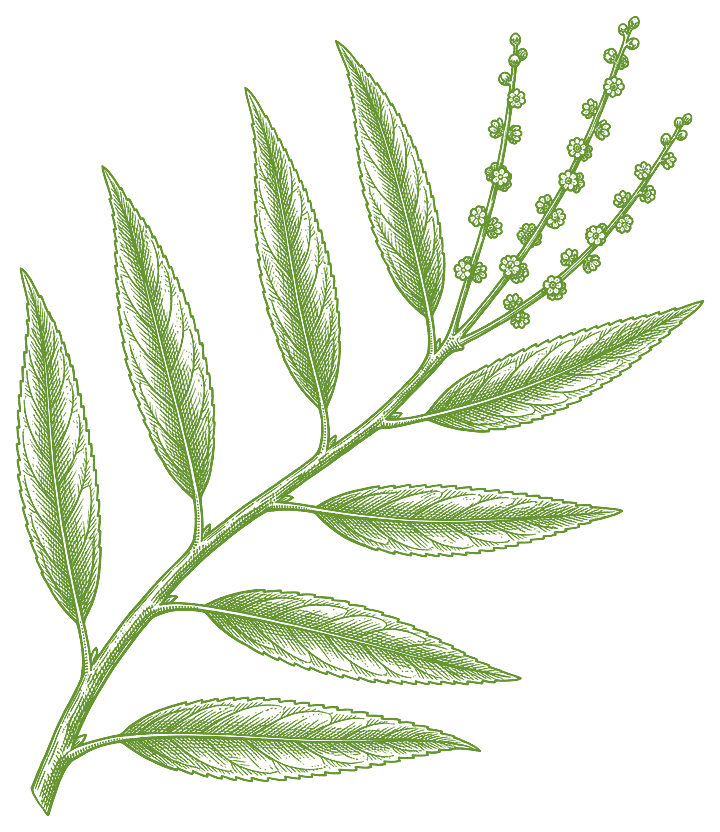
Iporuru is a shrub or small tree of wet tropical lowlands, up to about 6 meters (20 feet) tall[1, 8]. It is a plant of the water's edge. In the central Amazon it grows in young pioneer forest on sites where rivers deposit heavy loads of sediment[3], and herbarium collectors have found it in periodically flooded forest and riverside vegetation from Colombia to Brazil[4]. Because it can stand in floodwater for part of the year, it thrives where many trees cannot[4]. Away from the Amazon, it also reaches the cerrado savanna of Brazil, where it is part of local plant traditions too[3, 4].
The plant has a long scientific history. The explorers Alexander von Humboldt and Aimé Bonpland gave it its first name, Hermesia castaneifolia, which was published in 1806[1, 2, 6]. In 1824 it was moved into Alchornea, a genus of the spurge family, as part of a study of that family's genera[1, 2]. The spurge family is a large one that also includes cassava and the poinsettia[5].
Its common names change from country to country. In Peru it is iporuru, the name Raintree uses, or ipururo, and in Brazil it is oeirana[2, 7, 8]. In both countries iporuru belongs to local plant traditions: traditional practitioners in the Peruvian Amazon, among them the Shipibo-Conibo, and in Brazil's cerrado prepare it as a decoction, simmered in water[3].
Traditional uses
Clinical studies of iporuru in people are still few, but its traditional use is well established in the Peruvian Amazon and in Brazil.
A simple decoction
Iporuru is traditionally simmered in water and taken as a decoction.[3]
A healthy inflammatory response
Shipibo-Conibo practitioners in Peru and traditional practitioners in Brazil's cerrado prepare the decoction for this purpose. Iporuru supports a healthy inflammatory response.*[3]
Joint and muscle comfort
Plants of the Alchornea genus are traditional choices for the joints and muscles across the tropics[3]. Iporuru supports joint and muscle comfort.*
Plant compounds
Iporuru contains flavonoids, including quercetin and several of its glycosides (such as isoquercitrin), a myricetin glycoside and amentoflavone[3]. It also contains phenolic compounds such as gallic acid, methyl gallate and catechin[3]. Screening studies report tannins, saponins, steroids and triterpenoids as well[3].
Precautions
- Not for use during pregnancy or breastfeeding.
- If you take medication, talk to your healthcare practitioner before use.
- If you have a health condition, talk to your healthcare practitioner before use.
Where our iporuru comes from
Our iporuru leaf is wild-harvested. Every batch is tested for heavy metals, mold, yeast and pathogens.
- Wild-harvested
- South America
- Tested every batch
Raintree products with iporuru

Iporuru is also an ingredient in these Raintree products
Frequently asked questions
What is iporuru?
Iporuru is Alchornea castaneifolia, a shrub or small tree that grows on the riverbanks and floodplains of tropical South America. It belongs to the spurge family, the same family as cassava and the poinsettia. Iporuru is its Peruvian name.
What is iporuru called in English?
It has no everyday English name. English speakers use the Peruvian name, iporuru, or the scientific name, Alchornea castaneifolia.
Where does iporuru grow?
Along rivers and on floodplains in Venezuela, Colombia, Peru, Bolivia, Brazil, Paraguay and Argentina. It is a pioneer plant: it settles where floods leave fresh sediment and tolerates standing in floodwater for part of the year.
Which part of iporuru does Raintree use?
We use the leaf, wild-harvested.
How is iporuru traditionally prepared?
It is traditionally simmered in water and taken as a decoction. This is how traditional practitioners in the Peruvian Amazon and in Brazil's cerrado prepare it.
Is iporuru the same as Alchornea cordifolia?
No. Alchornea cordifolia is a related species native to tropical Africa. Iporuru is the South American species, Alchornea castaneifolia.
References
- Royal Botanic Gardens, Kew. Plants of the World Online: Alchornea castaneifolia (Humb. & Bonpl. ex Willd.) A.Juss.; Hermesia castaneifolia Humb. & Bonpl. ex Willd.; Alchornea cordifolia (Schumach. & Thonn.) Müll.Arg. powo.science.kew.org
- GBIF Secretariat. Alchornea castaneifolia and Hermesia castaneifolia: GBIF Backbone Taxonomy and checklist datasets, including Flora e Funga do Brasil – Lista Oficial (Instituto de Pesquisas Jardim Botânico do Rio de Janeiro). gbif.org
- Martínez CA, Mosquera OM, Niño J. Medicinal plants from the genus Alchornea (Euphorbiaceae): a review of their ethnopharmacology uses and phytochemistry. Boletín Latinoamericano y del Caribe de Plantas Medicinales y Aromáticas. 2017;16(3):162–205.
- GBIF.org. Occurrence records of Alchornea castaneifolia (preserved specimens, with collectors' habitat notes). gbif.org
- Encyclopaedia Britannica. Euphorbiaceae. britannica.com
- Encyclopaedia Britannica. Aimé Bonpland. britannica.com
- Royal Botanic Gardens, Kew. Medicinal Plant Names Services (MPNS): Alchornea castaneifolia. mpns.science.kew.org
- Mejía K, Rengifo E. Ipururo, Alchornea castaneifolia. In: Plantas medicinales de uso popular en la Amazonía peruana. 2nd ed. Lima: Agencia Española de Cooperación Internacional; Instituto de Investigaciones de la Amazonía Peruana (IIAP); 2000:112–113. repositorio.iiap.gob.pe (hdl:20.500.12921/74)