

 USD
USD


Did you know?
Sangre de grado and sangre de drago are both Spanish for "dragon's blood", after the red latex that runs from the cut bark[1, 2, 6].
Proanthocyanidins make up as much as 90% of the dried latex[1, 2, 4].
The latex is gathered from cuts in the bark, much as rubber is tapped[1, 2].
The name "dragon's blood" is shared by red resins from plants on other continents, including the dragon trees of Socotra and the Canary Islands and rattan palms of Southeast Asia[7, 8].
The ancient Greeks, Romans and Arabs all valued the Old World's dragon's blood, and it was later used to color varnishes and lacquers, including the varnish on violins[7, 8, 10].
The tree was named in 1866 by the botanist Johannes Müller Argoviensis, who had named huanarpo macho the year before[3, 9].
Origins and history
Sangre de grado is a fast-growing tree of the western Amazon[2]. It grows on the low mountain slopes where the Andes drop into the Amazon basin, from Colombia and Ecuador south through Peru to Bolivia[1, 3]. The botanist Johannes Müller Argoviensis gave it its scientific name in 1866, in the section on the spurge family that he wrote for de Candolle's great encyclopedia of plants, the Prodromus[3, 9].
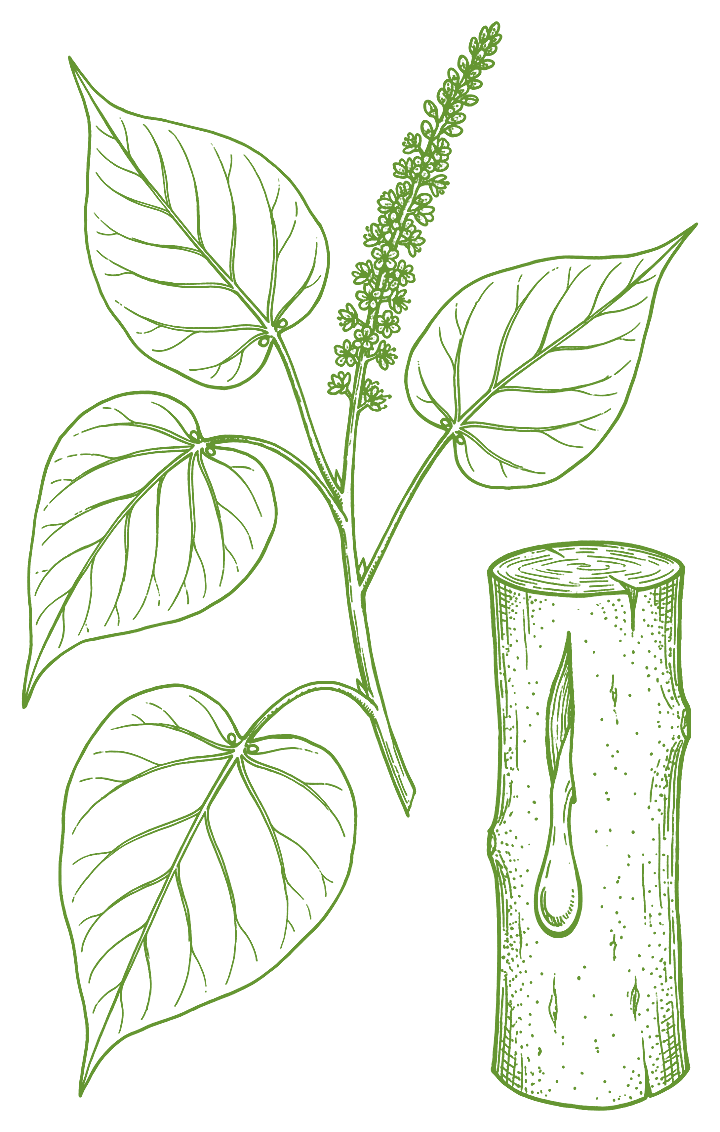
The tree is known for what happens when its bark is slashed. A thick latex seeps out, dark red like blood[1, 4], and it can be gathered from cuts in the trunk much as rubber is tapped[2]. That latex gave the tree all of its names: sangre de grado and sangre de drago in Spanish, dragon's blood in English[1, 2, 6]. In the upper Amazon it has two everyday traditions. A little is diluted in water and taken by mouth, and a little is rubbed onto the skin, where it dries into a protective seal[1, 2].
Europe already knew a "dragon's blood" long before anyone tapped a Croton tree. The name belonged to the red resin of dragon trees and rattan palms, valued by the ancient Greeks, Romans and Arabs and later used to color varnishes[7, 8, 10]. Today the Amazonian latex has become a trade good in its own right: it is one of the few Peruvian plant products marketed worldwide and is exported to North America and Europe[4, 5].
Traditional uses
Wherever the tree grows, its latex has two traditional uses: a little is taken in water, and a little is spread on the skin[1, 2].
Digestive comfort
In the upper Amazon a small amount of the latex is traditionally stirred into water and taken by mouth for digestive comfort.*[1, 2, 4]
A film on the skin
Rubbed onto the skin, the red latex dries into a thin film, a use recorded wherever the tree grows.[1, 2]
Antioxidant compounds
The latex provides naturally occurring antioxidant compounds.*[1, 4]
Plant compounds
Sangre de grado latex is remarkably rich in proanthocyanidins, which make up as much as 90% of its dry weight[1, 2, 4]. It also contains the related catechins catechin, epicatechin, gallocatechin and epigallocatechin[1, 4], an alkaloid called taspine[1, 2, 4] and a lignan called 3',4-O-dimethylcedrusin[1, 4].
Precautions
- Not for use during pregnancy or breastfeeding.
- If you take medication, talk to your healthcare practitioner before use.
- If you have a health condition, talk to your healthcare practitioner before use.
Where our sangre de grado comes from
Our sangre de grado latex is wild-harvested. Every batch is tested for heavy metals, mold, yeast and pathogens.
- Wild-harvested
- South America
- Tested every batch
Raintree products with sangre de grado


Frequently asked questions
What is sangre de grado in English?
Dragon's blood. Sangre de grado and sangre de drago are the Spanish names for the red latex of Croton lechleri, a tree of the upper Amazon.
Is sangre de grado the same as other dragon's blood?
Not always. "Dragon's blood" is a name for several red plant resins. Sangre de grado comes from Croton lechleri in South America, and a related tree, Croton draco, gives a red latex in Mexico. The dragon's blood of the Old World comes from dragon trees (Dracaena) on Socotra and the Canary Islands and from rattan palms (Daemonorops) in Southeast Asia.
How is sangre de grado harvested?
Harvesters cut into the bark and collect the dark red latex that seeps out, much as rubber is tapped.
What happens when sangre de grado is rubbed on the skin?
The latex dries into a thin, protective film that stays on the skin's surface.
Which part of sangre de grado does Raintree use?
We use the pure latex, often called resin, wild-harvested.
Where does sangre de grado grow?
It grows in Colombia, Ecuador, Peru and Bolivia, on the low mountain slopes where the Andes meet the Amazon basin.
References
- Iorizzi M, De Marino S, Gala F, Zollo F, Vitalini S, Fico G, Visioli F. Identification of minor secondary metabolites from the latex of Croton lechleri (Muell-Arg) and evaluation of their antioxidant activity. Molecules. 2008;13(6):1219–1229. doi:10.3390/molecules13061219
- Miller MJS, Vergnolle N, McKnight W, et al. Inhibition of neurogenic inflammation by the Amazonian herbal medicine sangre de grado. Journal of Investigative Dermatology. 2001;117(3):725–730. doi:10.1046/j.0022-202x.2001.01446.x
- Royal Botanic Gardens, Kew. Plants of the World Online: Croton lechleri Müll.Arg. powo.science.kew.org
- Lopes MILE, Saffi J, Echeverrigaray S, Henriques JAP, Salvador M. Mutagenic and antioxidant activities of Croton lechleri sap in biological systems. Journal of Ethnopharmacology. 2004;95(2–3):437–445. doi:10.1016/j.jep.2004.08.025
- Bussmann RW, Sharon D. Traditional medicinal plant use in Northern Peru: tracking two thousand years of healing culture. Journal of Ethnobiology and Ethnomedicine. 2006;2:47. doi:10.1186/1746-4269-2-47
- Jones K. Review of sangre de drago (Croton lechleri): a South American tree sap in the treatment of diarrhea, inflammation, insect bites, viral infections, and wounds: traditional uses to clinical research. Journal of Alternative and Complementary Medicine. 2003;9(6):877–896. doi:10.1089/107555303771952235
- Encyclopaedia Britannica. Dragon's blood. britannica.com
- Gupta D, Bleakley B, Gupta RK. Dragon's blood: botany, chemistry and therapeutic uses. Journal of Ethnopharmacology. 2008;115(3):361–380. doi:10.1016/j.jep.2007.10.018
- International Plant Names Index (IPNI). Author record: Müller Argoviensis, Johannes (Jean), 1828–1896; name records Croton lechleri Müll.Arg., Prodr. 15(2.2): 545 (1866) and Jatropha macrantha Müll.Arg., Linnaea 34: 209 (1865). ipni.org
- Namjoyan F, Kiashi F, Moosavi ZB, Saffari F, Makhmalzadeh BS. Efficacy of dragon's blood cream on wound healing: a randomized, double-blind, placebo-controlled clinical trial. Journal of Traditional and Complementary Medicine. 2016;6(1):37–40. doi:10.1016/j.jtcme.2014.11.029