

 USD
USD


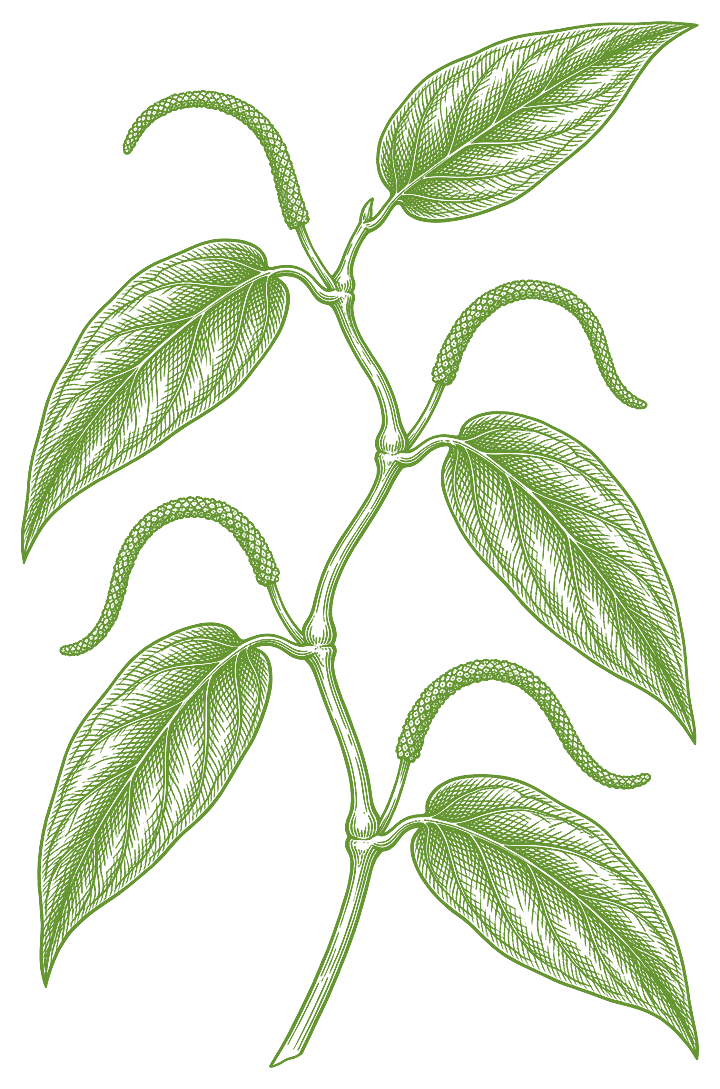
Did you know?
Aduncum is Latin for "hooked" or "curved"[9, 10], and one Portuguese name, pimenta-do-fruto-ganchoso, means "hooked-fruit pepper"[4].
Matico belongs to Piper, the genus of black pepper, cubeb and kava[5, 6].
Spanish speakers call it cordoncillo, "little cord." Its slender white flower spikes do look like short lengths of cord[1, 3, 4].
In Ecuador one of its names is hierba del soldado, "soldier's herb"[4].
Far from home, it has become an invasive weed on Pacific islands such as Fiji and the Solomon Islands, where it can get mixed into harvests of its cousin kava[1, 2, 3].
Its small fruits taste peppery and have been used as a spice[3].
Origins and history
Matico is a shrub or small tree, usually 6 to 20 feet (2 to 6 m) tall, with long leaves up to about 10 inches (26 cm)[1, 3]. Its minute flowers are packed along slender white spikes 3 to 6 inches (8 to 15 cm) long, which ripen into tiny fruits with black seeds, and it can flower and fruit all year round[1, 3, 5]. It grows wild from Mexico and the Caribbean islands through Central America and South America to northern Argentina[1, 2, 3], and Carl Linnaeus named it in 1753[1, 4].
In Peru and Ecuador the plant is called matico[1, 4, 7]. By the late 1800s dried matico leaves from Peru were known in the United States, and American herbal reference books described them as aromatic and bitter, with a camphor-like oil[7, 8]. Those books called the plant Piper angustifolium, a name botanists now count as the same species as Piper aduncum[1, 7, 8]. It has gathered other names too: cordoncillo and higuillo in Spanish, spiked pepper, bamboo piper, false kava and jointwood in English, and hierba del soldado in Ecuador[2, 4].
Matico is a plant of the kitchen as well as the herb shelf. Its small fruits have a peppery flavor and are used as a spice, its leaves are cooked as a potherb, and its small timber serves for stakes, fences and fuel[3]. From its home in the Americas it has spread to Florida, Hawaii, Southeast Asia and the islands of the Pacific[1, 2, 4]. Birds and bats carry its seeds, and it also spreads by suckers into large clumps[2]. In parts of the Pacific it is now an invasive weed, and it can end up mixed into kava harvests[2, 3].
Traditional uses
Clinical studies of matico in people are still few, but its traditional use is rich and spread right across the tropical Americas[6].
For the stomach
In Jamaica, as in parts of Africa, an infusion of matico leaves is a traditional drink for the stomach, and in the wider Caribbean a tea of the leaves and roots is taken for occasional queasiness.[6] Early American herbal texts described matico as an aromatic bitter[8]. Matico supports digestive comfort.
Urinary tract
In Mexico and the Caribbean, matico's traditional uses include the urinary tract. Matico helps promote urinary tract health.*[6, 8]
Chest and airways
Matico also has a tradition of use for the chest and airways. Matico supports respiratory health.*[6]
A peppery spice
The fruits are used to season food.[3]
Plant compounds
Matico leaves contain an aromatic essential oil whose make-up changes from region to region[6, 11]. In plants from the Amazon it is dominated by dillapiole, while oils from other places are richer in terpenes such as 1,8-cineole[6, 11]. Camphor has been reported in the oil, and 19th-century herbal texts already noted the leaves' camphor-like character[6, 7, 8, 11].
Precautions
- Not for use during pregnancy or breastfeeding.
- If you take medication, talk to your healthcare practitioner before use.
Where our matico comes from
Our matico leaf is wild-harvested. Every batch is tested for heavy metals, mold, yeast and pathogens.
- Wild-harvested
- South America
- Tested every batch
Raintree products with matico
Matico is also an ingredient in these Raintree products

Frequently asked questions
What is matico?
Matico is Piper aduncum, a shrub or small tree of the pepper family native to the American tropics, from Mexico and the Caribbean to northern Argentina. Its leaves have a long tradition of use across Latin America and the Caribbean.
Is matico related to black pepper?
Yes. Matico belongs to Piper, the same genus as black pepper, cubeb and kava. Its small fruits taste peppery and have been used as a spice.
Why is matico called spiked pepper?
Its minute flowers, and later its fruits, are packed along slender spikes, as in other peppers, which is where the English name spiked pepper comes from.
What does matico smell like?
The leaves are aromatic and slightly bitter, and their essential oil has a camphor-like character. The fruits have a peppery flavor.
Is matico invasive?
Not in its native range, which runs from Mexico and the Caribbean to northern Argentina. Where it has been introduced, especially on Pacific islands such as Fiji and the Solomon Islands, it has become an invasive weed.
Which part of matico does Raintree use?
We use the leaf, wild-harvested.
References
- Royal Botanic Gardens, Kew. Plants of the World Online: Piper aduncum L. (with synonym Piper angustifolium Ruiz & Pav.). powo.science.kew.org
- Global Invasive Species Database (GISD). Piper aduncum. IUCN SSC Invasive Species Specialist Group. iucngisd.org
- Fern K. Piper aduncum. Useful Tropical Plants Database. tropical.theferns.info
- GBIF Secretariat. Piper aduncum L. GBIF Backbone Taxonomy, vernacular names (Catalogue of Life; GRIN Taxonomy; ITIS; Listado de plantas de uso y aprovechamiento sostenible en Ecuador; Global Register of Introduced and Invasive Species, Hawaii). gbif.org
- Encyclopaedia Britannica. Piperaceae. britannica.com
- Salehi B, Zakaria ZA, Gyawali R, et al. Piper species: a comprehensive review on their phytochemistry, biological activities and applications. Molecules. 2019;24(7):1364. doi:10.3390/molecules24071364
- Felter HW, Lloyd JU. Matico. King's American Dispensatory. 1898. henriettes-herb.com
- Felter HW. Matico. The Eclectic Materia Medica, Pharmacology and Therapeutics. 1922. henriettes-herb.com
- Olivetti Latin Dictionary. Aduncus. online-latin-dictionary.com
- Latin Dictionary. Aduncus. latin-dictionary.net
- da Silva JK, da Trindade R, Alves NS, Figueiredo PL, Maia JGS, Setzer WN. Essential oils from neotropical Piper species and their biological activities. International Journal of Molecular Sciences. 2017;18(12):2571. doi:10.3390/ijms18122571