

 USD
USD


Did you know?
Bellaco caspi was first described as a frangipani: botanists published it in 1860, in Flora Brasiliensis, as Plumeria sucuuba[4, 5].
Frangipani, oleander and periwinkle are all its relatives in the dogbane family[3, 8].
Its species name, sucuuba, is the tree's popular name in the Brazilian Amazon; in Peru the same tree is bellaco caspi[1, 6, 7, 9].
In the Central Amazon it grows both on dry uplands and in floodplain forests that stand under water for months at a time[10, 11].
In flooding trials, seedlings grown from floodplain trees survived four months completely under water, while seedlings from upland trees did not[10, 11].
Botanists now regard bellaco caspi as part of a species with an older name, Himatanthus articulatus, first described as Plumeria articulata[4, 7].
Origins and history
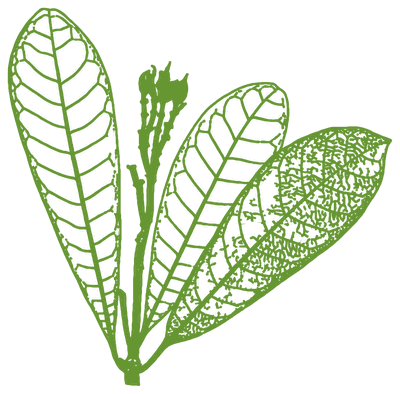
Bellaco caspi is a tree of lowland tropical forest. It usually grows 8 to 16 meters (about 26 to 52 feet) tall on a straight trunk 30 to 40 centimeters (12 to 16 inches) across[1, 2], with a narrow, pyramid-shaped crown[2]. Its bright green leaves are about 25 to 30 centimeters (10 to 12 inches) long[1], and it bears white, fragrant flowers[1, 2]. Like many members of the dogbane family, it is full of milky sap: cut the bark and a white latex runs out[1, 2, 3]. In Brazil it grows across the Amazon and into the Cerrado region[4, 7], and in the Central Amazon it is one of the trees found both in seasonally flooded forests and on higher ground that never floods[10, 11].
The tree entered botany in 1860, published in Flora Brasiliensis as Plumeria sucuuba, the genus of the frangipanis[4, 5, 8]. The name was Richard Spruce's, published on his behalf by the botanist Johannes Müller Argoviensis[4, 5]. In the 1930s it was moved into the genus Himatanthus[4, 6]. Today Kew's Plants of the World Online and Brazil's national flora go one step further and include it in Himatanthus articulatus[4, 7]. Herbalists and researchers still mostly call it Himatanthus sucuuba[1, 12, 13].
Its common names follow the map. In Brazil it is sucuuba or sucuúba, and janaguba in the northeast[6, 7]; in Peru it is bellaco caspi[1, 9]. Beyond its place in folk practice, its wood is made into boxes, tool handles and toys, and the tree is also cut for firewood[2, 4].
Traditional uses
Clinical studies in people are still few, but its traditional use across the Amazon is rich, and it rests on two parts of the tree: the bark and the white latex[1, 14].
Bark and latex
In the open-air markets of Belém, in the Brazilian Amazon, the bark is sold in pieces or as a powder for making tea. The fresh white latex is gathered by cutting into the tree.[1, 14]
Joint and back comfort
Amazonian folk practice turns to the bark and latex of bellaco caspi for comfortable joints and a comfortable back. Bellaco caspi supports joint comfort and a healthy inflammatory response.*[1, 12, 14]
Digestive comfort
The latex, and a tea simmered from the leaves, have also been taken traditionally for the stomach. Bellaco caspi supports digestive comfort.*[1, 14]
Plant compounds
Bellaco caspi contains iridoids, a group of naturally occurring plant compounds; plumericin, the best known of them, has been reported in the tree by separate research teams[1, 13]. It also contains triterpenes, including lupeol and several related triterpene esters[1, 2, 13].
Precautions
- Not for use during pregnancy or breastfeeding.
- If you take medication or have a health condition, talk to your healthcare practitioner before use.
Where our bellaco caspi comes from
Our bellaco caspi bark is wild-harvested in the Peruvian Amazon. Every batch is tested for heavy metals, mold, yeast and pathogens.
- Wild-harvested
- Peru
- Tested every batch
Raintree products with bellaco caspi
 CapsulesBellaco Caspi CapsulesBellaco caspi bark (Himatanthus sucuuba), 500 mg per capsule, nothing added.Out of stockView product →
PowderBellaco caspi powderOut of stockView product →
CapsulesBellaco Caspi CapsulesBellaco caspi bark (Himatanthus sucuuba), 500 mg per capsule, nothing added.Out of stockView product →
PowderBellaco caspi powderOut of stockView product →
 ExtractBellaco caspi extractOut of stockView product →
Bellaco Caspi is also an ingredient in these Raintree products

Frequently asked questions
What is bellaco caspi?
Bellaco caspi is the Peruvian name for Himatanthus sucuuba, a rainforest tree of the dogbane family that contains a milky white latex. It grows from Panama to Bolivia and Brazil.
Is bellaco caspi the same as sucuuba?
Yes. Sucuuba, also written sucuúba, is the tree's name in Brazil, and bellaco caspi is its name in Peru. Both refer to Himatanthus sucuuba.
Is Himatanthus sucuuba the same as Himatanthus articulatus?
Kew's Plants of the World Online and Brazil's national plant list now include Himatanthus sucuuba in Himatanthus articulatus, the older name. Most herbal and research writing still uses Himatanthus sucuuba.
Is bellaco caspi related to frangipani?
Yes. Both belong to the dogbane family, and bellaco caspi was first described as a frangipani, Plumeria sucuuba, before botanists moved it to the genus Himatanthus.
Which part of bellaco caspi does Raintree use?
We use the bark, wild-harvested in the Peruvian Amazon; our extract is made from the bark and resin.
Where does bellaco caspi grow?
It grows in lowland tropical forests from Panama through Colombia, Venezuela and the Guianas to Ecuador, Peru, Bolivia and Brazil. In the Central Amazon it thrives both in forests that flood for months each year and on dry uplands.
References
- Herrera-Calderón O, Calero-Armijos LL, Cardona-G W, Herrera-R A, Moreno G, Algarni MA, Alqarni M, Batiha GE. Phytochemical screening of Himatanthus sucuuba (Spruce) Woodson (Apocynaceae) latex, in vitro cytotoxicity and incision wound repair in mice. Plants. 2021;10(10):2197. doi:10.3390/plants10102197
- Fern K. Himatanthus sucuuba. Useful Tropical Plants Database. tropical.theferns.info
- Encyclopaedia Britannica. Apocynaceae (dogbane family). britannica.com
- Royal Botanic Gardens, Kew. Plants of the World Online: Himatanthus articulatus (Vahl) Woodson, with synonyms Himatanthus sucuuba and Plumeria sucuuba. powo.science.kew.org
- International Plant Names Index. Plumeria sucuuba Spruce ex Müll.Arg., Flora Brasiliensis 6(1): 40 (1860). ipni.org
- GBIF Secretariat. Himatanthus sucuuba (Spruce ex Müll.Arg.) Woodson (synonym) and Himatanthus articulatus (Vahl) Woodson: GBIF Backbone Taxonomy and vernacular names. gbif.org
- Flora e Funga do Brasil. Himatanthus articulatus (Vahl) Woodson. Jardim Botânico do Rio de Janeiro. floradobrasil.jbrj.gov.br
- Encyclopaedia Britannica. Frangipani. britannica.com
- Royal Botanic Gardens, Kew. Medicinal Plant Names Services: Himatanthus articulatus. mpns.science.kew.org
- Ferreira CS, Piedade MTF, Junk WJ, Parolin P. Floodplain and upland populations of Amazonian Himatanthus sucuuba: effects of flooding on germination, seedling growth and mortality. Environmental and Experimental Botany. 2007;60(3):477–483. doi:10.1016/j.envexpbot.2007.01.005
- Ferreira CS, Piedade MTF, Franco AC, Gonçalves JFC, Junk WJ. Adaptive strategies to tolerate prolonged flooding in seedlings of floodplain and upland populations of Himatanthus sucuuba, a Central Amazon tree. Aquatic Botany. 2009;90(3):246–252. doi:10.1016/j.aquabot.2008.10.006
- Silva MB da, Silva MP da, Reis Júnior JDD dos, Lima CAC, Souza AO de. Therapeutics activities of Amazonian plant Himatanthus sucuuba (Spruce ex Müll. Arg.) Woodson (Apocynaceae): a review. Journal of Advances in Biology & Biotechnology. 2021;24(2):1–14. doi:10.9734/jabb/2021/v24i230197
- Wood CA, Lee K, Vaisberg AJ, Kingston DGI, Neto CC, Hammond GB. A bioactive spirolactone iridoid and triterpenoids from Himatanthus sucuuba. Chemical and Pharmaceutical Bulletin. 2001;49(11):1477–1478. doi:10.1248/cpb.49.1477
- dos Santos Silva A, Carvalho de Souza E, de Araújo Tortola D, da Silva Pinheiro D, Sarkis Muller RC. Análise de parâmetros físico-químicos de chás de casca de sucuúba (Himathantus sucuuba) e sua distinção conforme o estado das cascas (em pedaços ou pulverizadas). 54º Congresso Brasileiro de Química; 2014. Associação Brasileira de Química. abq.org.br