

 USD
USD


Did you know?
Cat's claw belongs to the same plant family as coffee and quinine[1, 8].
The vine can climb about 30 meters into the forest canopy, hooking itself on with its curved thorns[2, 3].
The Asháninka call the vine savéntaro, "powerful plant", from their words for "plant" and "potent"[2], and their priests gather only vines of one of its two natural chemical types[2, 5].
Its stems hold a drinkable, watery sap that people use to quench their thirst[3]. In Trinidad the vine is known as liane d'eau, "water vine"[4].
A vine takes eight years or more to reach harvest size, and when it is cut above the ground rather than pulled up, it grows back[3].
Cat's claw is not devil's claw, a different plant native to southern Africa[1, 9], and in Peru's markets the name "cat's claw" is given to many different plants[2].
Origins and history
Cat's claw grows in the wet tropical forests of Central and South America, mostly below 1,000 meters, where it scrambles up through the trees on hooked thorns[1, 2, 3]. Its bark and watery sap have been known to the peoples of the Amazon for generations[3, 5].
In the early 1970s the Austrian Klaus Keplinger organized the first scientific studies of the vine[6]. His work led to cat's claw extracts sold in Austria and Germany and to a series of US patents on methods of extracting the bark's oxindole alkaloids, the first granted in 1989[6, 10]. By the 1990s the bark was being gathered in large quantities from Peru's forests[11], and by 1997 more than 50 US supplement makers sold it[7]. The boom brought a new concern: protecting the wild vines. In 1999 Peru banned the export of raw or only mechanically processed cat's claw unless it came from managed forest areas or plantations, and called for management plans for the harvest[11]. Harvesters cut the vine above the ground so it can grow back, rather than pulling up the root[3].
Traditional uses
Clinical studies in people are still few and small[7, 9], but cat's claw's place in Amazonian tradition is long and well documented.
A bitter bark tea
The Asháninka and other Peruvian peoples have traditionally boiled slices of the bark into a bitter tea, taken regularly to stay well.*[2, 6, 7]
Immune support
Joint comfort
Traditionally taken to support joint comfort and flexibility.*[6, 7]
Digestive comfort
Antioxidant compounds
The bark provides naturally occurring antioxidant compounds.*[2, 12]
Plant compounds
Cat's claw bark contains oxindole alkaloids[6, 7]. The best known are pentacyclic ones, such as mitraphylline, pteropodine, isopteropodine, speciophylline and uncarine F, and tetracyclic ones, such as rhynchophylline[2, 6, 7]. The bark also contains quinovic acid glycosides, proanthocyanidins (such as catechin and epicatechin) and plant sterols[2, 6, 12]. The vine grows in two natural chemical types, one richer in pentacyclic and one in tetracyclic oxindole alkaloids[5, 6]. Asháninka priests can tell the two apart, and how they do it is still unknown to scientists[5].
Precautions
- Not for use during pregnancy or breastfeeding[6, 9, 13].
- If you take medication, especially blood thinners, blood-pressure medication, immunosuppressants or protease inhibitors, talk to your healthcare practitioner before use[7, 9, 13].
- If you have an autoimmune condition, talk to your healthcare practitioner before use[9, 13].
- Stop taking cat's claw before scheduled surgery[7, 9, 13].
Where our cat's claw comes from
Our cat's claw inner vine bark is wild-harvested. Every batch is tested for heavy metals, mold, yeast and pathogens.
- Wild-harvested
- South America
- Tested every batch
Raintree products with cat's claw
 CapsulesCat's Claw CapsulesCat's claw bark, 500 mg per capsule.Out of stockView product →
 PowderCat's claw powderOut of stockView product →
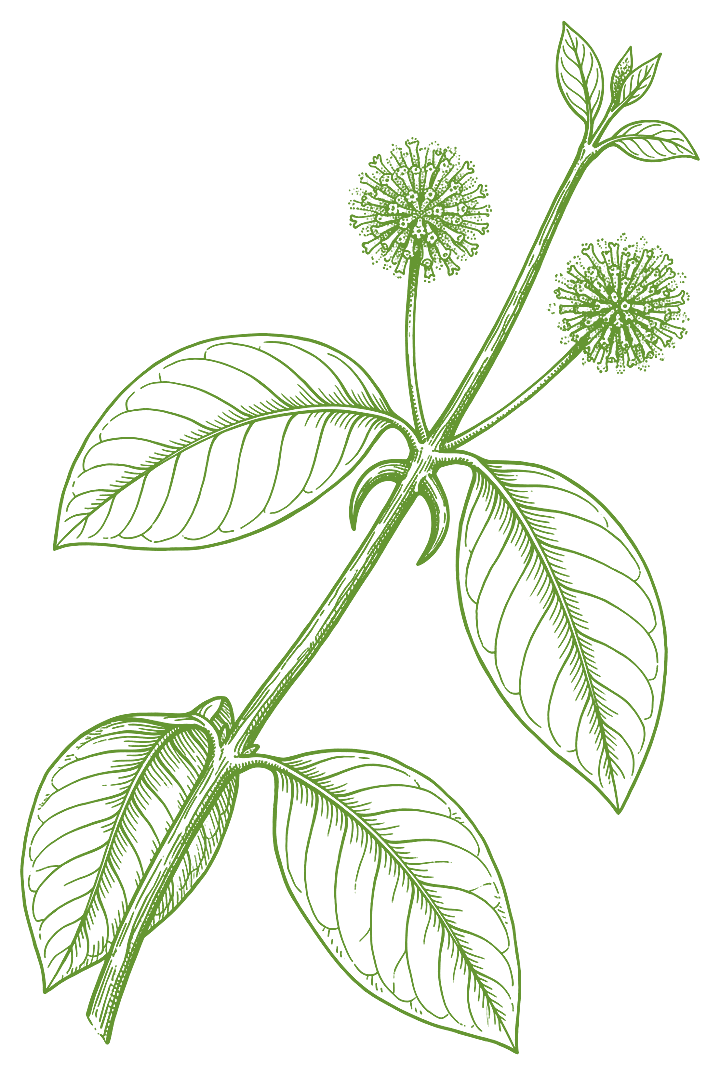 ExtractCat's claw extractOut of stockView product →
Cat's claw is also an ingredient in these Raintree products


Frequently asked questions
Why is it called cat's claw?
For the curved, hooked thorns along its stems, which look like a cat's claws and let the vine climb into the forest canopy.
What is cat's claw called in Spanish?
Uña de gato, which means "cat's claw". In Portuguese it is unha-de-gato.
Is cat's claw the same as devil's claw?
No. Devil's claw is a different plant from southern Africa. Two related Amazonian vines, however, are both sold as cat's claw: Uncaria tomentosa, the species most often found in US products, and Uncaria guianensis.
Which part of cat's claw is used?
The bark of the vine. Raintree uses the inner vine bark, which is wild-harvested.
How is cat's claw traditionally prepared?
Slices of bark are simmered in water for 30 to 45 minutes to make a bitter tea, then strained and drunk warm.
Where does cat's claw grow?
In the wet tropical forests of Central and South America, from Guatemala to Bolivia and east to the Guianas and Trinidad, and especially in the Amazon regions of Peru and Brazil.
References
- Royal Botanic Gardens, Kew. Plants of the World Online: Uncaria tomentosa (Willd. ex Schult.) DC.; Harpagophytum procumbens (Burch.) DC. (devil's claw). powo.science.kew.org
- Marques O, Figueirinha A, Pina ME, Batista MT. Uncaria tomentosa as a promising natural source of molecules with multiple activities. International Journal of Molecular Sciences. 2025;26(14):6758. doi:10.3390/ijms26146758
- Fern K. Uncaria tomentosa. Useful Tropical Plants Database. tropical.theferns.info
- GBIF Secretariat. Uncaria tomentosa (Willd. ex Schult.) DC.: vernacular names (Catalogue of Life; GRIN Taxonomy; Flora e Funga do Brasil – Lista Oficial). GBIF Backbone Taxonomy. gbif.org/species/5338267
- Keplinger K, Laus G, Wurm M, Dierich MP, Teppner H. Uncaria tomentosa (Willd.) DC.: ethnomedicinal use and new pharmacological, toxicological and botanical results. Journal of Ethnopharmacology. 1999;64(1):23–34. doi:10.1016/S0378-8741(98)00096-8
- European Medicines Agency, Committee on Herbal Medicinal Products. Assessment report on Uncaria tomentosa (Willd. ex Schult.) DC., cortex. 2015. ema.europa.eu
- Drugs.com. Cat's claw. The Review of Natural Products (professional monograph). drugs.com/npp/cat-s-claw.html
- Encyclopaedia Britannica. Rubiaceae. britannica.com
- National Center for Complementary and Integrative Health (NCCIH). Cat's claw. nccih.nih.gov
- Keplinger K, Wagner H, Kreutzkamp B. Oxindole alkaloids having properties stimulating the immunologic system. US Patent 4,844,901. Granted 4 July 1989. patents.google.com/patent/US4844901A
- Republic of Peru, Ministerio de Agricultura. Decreto Supremo Nº 009-99-AG (28 March 1999), on the export of uña de gato species. FAOLEX database, Food and Agriculture Organization of the United Nations. faolex.fao.org/docs/pdf/per15969.pdf
- Heitzman ME, Neto CC, Winiarz E, Vaisberg AJ, Hammond GB. Ethnobotany, phytochemistry and pharmacology of Uncaria (Rubiaceae). Phytochemistry. 2005;66(1):5–29. doi:10.1016/j.phytochem.2004.10.022
- RxList. Cat's claw: health benefits, side effects, uses, dose and precautions. rxlist.com/cats_claw/supplements.htm