

 USD
USD


Did you know?
Clavo means both "nail" and "clove" in Spanish. The spice itself was named for its nail-like shape, from the Latin clavus, "nail"[9, 11].
Huasca comes from the Quechua waskha, "rope", a fitting word for a vine[9, 10].
In Brazil, Tynanthus vines are called cipó-cravo, "clove vine", and a clove scent is one of the features botanists use to recognize the genus[3, 4, 5].
Eugenol, the compound behind the vine's scent, is a major component of clove oil and has an odor of cloves all by itself[12, 14].
Clavo huasca belongs to the same plant family as the jacaranda tree, the catalpa and the trumpet creeper[2, 13].
Cut one of its vines across and you may see a cross. Clavo huasca belongs to the Bignonieae, a tribe of climbing vines whose stems grow wedges of inner bark into the wood from four evenly spaced points[3, 15, 16]. A North American relative, the crossvine, is named for the pattern[17].
Origins and history
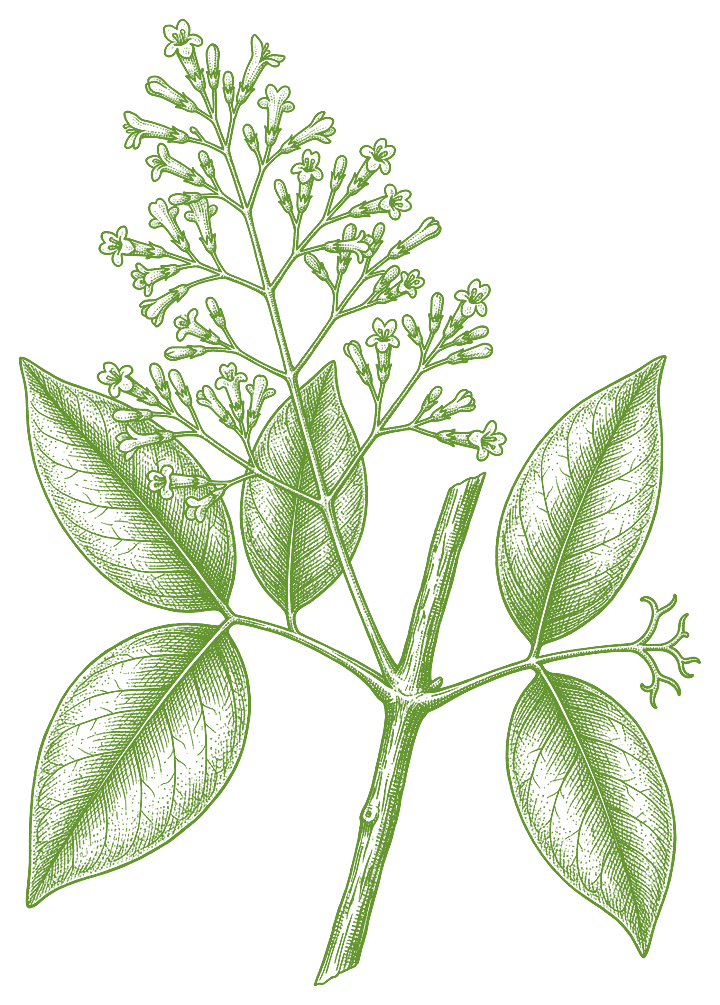
Clavo huasca is a liana: a woody vine that roots in the forest floor and climbs up through the trees of the Amazon's wet forests[1, 7, 8]. It belongs to Tynanthus, a small genus of American lianas that ranges from southern Mexico to southern Brazil and is recognized by its clove scent[3, 4]. Botanists first described the species as Schizopsis panurensis; it was later moved into Tynanthus, the genus where it sits today[1, 2, 8].
Its common name is a plain description. Clavo is Spanish for clove, and huasca comes from the Quechua word for rope, a natural word for a vine; together they make "clove vine"[9, 10, 11]. In Brazil people use the same image for its relatives, calling Tynanthus vines cipó-cravo[3, 5]. The scent is real chemistry: the plant contains eugenol and eugenol-based compounds, and eugenol is a major component of clove oil[6, 8, 12, 14].
In Amazonian folk practice, it is the bark that is valued[6, 7]. The vine is part of folk tradition across the Amazon, with records of its use from Brazil, Ecuador and Peru[7, 8]. Locally, the clove-scented plant is also brewed as a tea and used as a spice[8].
Traditional uses
Clinical studies of clavo huasca in people are still few, but its traditional use across the Amazon is rich and remarkably consistent[7, 8].
A tonic for energy and vitality
In Amazonian folk tradition, clavo huasca bark is taken as a tonic to support energy and vitality.*[7, 8]
A tonic for men and women
In Brazil, Ecuador and Peru it is also a traditional tonic for men, and in Peru for women too; it supports a healthy libido.*[8]
Joint comfort
In Brazil, Ecuador and Peru, clavo huasca has a long tradition of use for the joints; it supports joint function and comfort.*[7, 8]
Digestive comfort
In Brazil it is also a traditional digestive herb, and it supports healthy digestion.*[8]
Antioxidant compounds
The bark provides naturally occurring antioxidant compounds.*[6, 7]
Plant compounds
The bark is rich in phenolic compounds[6, 7]. Chemists have identified several phenylpropanoid glycosides in it, such as verbascoside, isoverbascoside and leucosceptoside, along with a eugenol-based glycoside that was new to science and turned out to be the most abundant of them[6]. Eugenol itself, a major component of clove oil, occurs in the essential oil of the wood and leaves[8, 14]. Eugenol is a phenylpropanoid too, so the vine's clove scent and its best-studied bark compounds belong to the same chemical group[6, 14].
Precautions
- Not for use during pregnancy or breastfeeding.
- If you take medication, talk to your healthcare practitioner before use.
Where our clavo huasca comes from
Our clavo huasca vine wood and vine bark are wild-harvested. Every batch is tested for heavy metals, mold, yeast and pathogens.
- Wild-harvested
- South America
- Tested every batch
Raintree products with clavo huasca
Frequently asked questions
What is clavo huasca in English?
Clove vine. Clavo is Spanish for clove, and huasca comes from the Quechua word for rope, so the name describes a clove-scented vine. Botanically it is Tynanthus panurensis.
What does clavo huasca smell like?
It smells of cloves. Its wood and leaves contain eugenol, the same aromatic compound that gives cloves their scent.
Is clavo huasca the same as cloves?
No. Cloves are the dried flower buds of the clove tree, Syzygium aromaticum. Clavo huasca is an unrelated Amazonian vine that shares the clove scent because it contains the same aromatic compound, eugenol.
Which part of clavo huasca does Raintree use?
We use the vine wood in our capsules and powder and the vine bark in our extract, all wild-harvested.
Where does clavo huasca grow?
It grows wild in the moist tropical forests of the Amazon basin, from southern Colombia through Ecuador and Peru to northeastern Bolivia and northern Brazil, climbing up through the trees as a woody vine.
Is clavo huasca the same as cipó-cravo?
They are close relatives. Cipó-cravo, "clove vine", is the Brazilian name for clove-scented Tynanthus vines, the genus clavo huasca belongs to.
References
- Plants of the World Online. Tynanthus panurensis (Bureau) Sandwith. Royal Botanic Gardens, Kew. powo.science.kew.org
- GBIF Secretariat. Tynanthus panurensis (Bureau) Sandwith; Jacaranda mimosifolia D.Don. GBIF Backbone Taxonomy. gbif.org
- de Medeiros MCMP, Lohmann LG. Taxonomic revision of Tynanthus (Bignonieae, Bignoniaceae). Phytotaxa. 2015;216(1):1–60. doi:10.11646/phytotaxa.216.1.1
- de Medeiros MCMP, Lohmann LG. Phylogeny and biogeography of Tynanthus Miers (Bignonieae, Bignoniaceae). Molecular Phylogenetics and Evolution. 2015;85:32–40. doi:10.1016/j.ympev.2015.01.010
- de Medeiros MCMP, Lohmann LG. Two new species of Tynanthus Miers (Bignonieae, Bignoniaceae) from Brazil. PhytoKeys. 2014;42:77–85. doi:10.3897/phytokeys.42.8210
- Plaza A, Montoro P, Benavides A, Pizza C, Piacente S. Phenylpropanoid glycosides from Tynanthus panurensis: characterization and LC-MS quantitative analysis. Journal of Agricultural and Food Chemistry. 2005;53(8):2853–2858. doi:10.1021/jf0479867
- Morales L, Acero N, Galán A, Perez-García C, Alguacil LF, Muñoz-Mingarro D. Bioactive properties of Tynanthus panurensis (Bureau) Sandwith bark extract, the Amazonian "clavo huasca". Journal of Medicinal Food. 2011;14(9):939–943. doi:10.1089/jmf.2010.0171
- Fern K. Tynanthus panurensis. Useful Tropical Plants Database. tropical.theferns.info
- Real Academia Española. Diccionario de la lengua española: "clavo"; "guasca". dle.rae.es
- Asociación de Academias de la Lengua Española. Diccionario de americanismos: "huasca". asale.org
- Online Etymology Dictionary. Clove. etymonline.com
- Encyclopaedia Britannica. Clove. britannica.com
- Encyclopaedia Britannica. Bignoniaceae. britannica.com
- National Center for Biotechnology Information. PubChem Compound Summary for CID 3314, Eugenol. pubchem.ncbi.nlm.nih.gov
- Pace MR, Lohmann LG, Angyalossy V. The rise and evolution of the cambial variant in Bignonieae (Bignoniaceae). Evolution & Development. 2009;11(5):465–479. doi:10.1111/j.1525-142X.2009.00355.x
- Pace MR, Alcantara S, Lohmann LG, Angyalossy V. Secondary phloem diversity and evolution in Bignonieae (Bignoniaceae). Annals of Botany. 2015;116(3):333–358. doi:10.1093/aob/mcv106
- North Carolina State University Extension. North Carolina Extension Gardener Plant Toolbox: Bignonia capreolata (crossvine). plants.ces.ncsu.edu