

 USD
USD


Did you know?
"Pau d'arco" is Portuguese for "bow stick": the wood was prized for hunting bows[3, 4].
Ipê, its Brazilian name, comes from the Tupi for "thick-barked tree"[9, 10].
The tree drops its leaves just before it flowers, so it blooms in pink and purple on bare branches, roughly June to September in the south[3, 9, 10].
Ipê, the timber of pau d'arco's genus, Handroanthus, is so dense that most pieces sink in water. It was used for the boardwalk at New York's Coney Island, where it is said to have lasted 25 years before it needed replacing[11].
Brazilians name their ipê trees by flower color: pau d'arco is ipê-roxo, the purple ipê, while its relatives include ipê-amarelo (yellow) and ipê-branco (white)[7, 12].
Since 2024, international trade in ipê timber has been controlled under CITES to protect wild trees[11, 13].
Origins and history
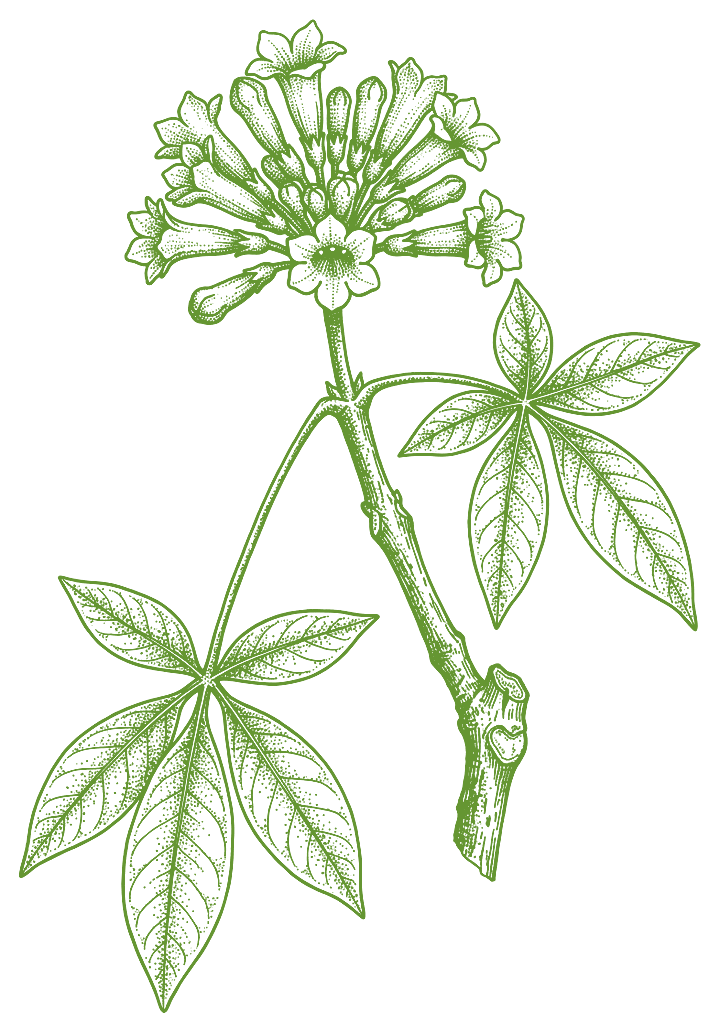
Pau d'arco is a deciduous tree that can reach 30 meters, with a trunk up to 80 centimeters (about 2.5 feet) across, leaves divided like the fingers of a hand, trumpet-shaped flowers and exceptionally hard, durable wood[2, 3, 9]. It grows from Mexico to northern Argentina, in rainforest and in the drier forests and savannas of central Brazil[1, 9]. In Brazil alone its range runs from Maranhão in the north to Rio Grande do Sul in the far south[9].
Its botanical name has changed with science. For most of the twentieth century it was known as Tabebuia, from a Tupi-Guarani word said to mean "stick" or "floating wood"[10]; in 1970 the Brazilian botanist Mattos placed it in a new genus, Handroanthus, and in 2007, after DNA studies, botanists confirmed that the dense-wooded trees rich in lapachol belong together there[1, 14, 15]. Through all the renaming, the peoples of South America kept one use constant: the inner bark, simmered into a strong tea[7, 8]. In the herb trade the name pau d'arco is also used for the inner bark of a few close relatives, notably Tabebuia heptaphylla[4, 7].
Traditional uses
Clinical studies in people are still few and small[3, 7], but pau d'arco has a long and widespread tradition across South America.
An inner-bark tea
The inner bark is traditionally simmered in water to make a strong tea, called a decoction.[7, 8]
Immune support
Pau d'arco supports healthy immune function.*[3]
Healthy-looking skin
A strong tea of the inner bark, or a poultice, has traditionally been applied to the skin. Pau d'arco supports healthy-looking skin.*[3, 8]
Digestive comfort
A decoction of the inner bark has traditionally been taken for the stomach, to support digestive comfort.*[8]
Plant compounds
Pau d'arco's best-known compounds are naphthoquinones, especially lapachol and beta-lapachone[3, 7]. The inner bark also contains anthraquinones, flavonoids, iridoids and lignans[3, 16].
Precautions
Where our pau d'arco comes from
Our pau d'arco inner bark is wild-harvested in Peru. Every batch is tested for heavy metals, mold, yeast and pathogens.
- Wild-harvested
- Peru
- Tested every batch
Raintree products with pau d'arco
 CapsulesPau d'Arco CapsulesPau d'arco inner bark, 500 mg per capsule.Out of stockView product →
PowderPau d'arco powderOut of stockView product →
CapsulesPau d'Arco CapsulesPau d'arco inner bark, 500 mg per capsule.Out of stockView product →
PowderPau d'arco powderOut of stockView product →
 ExtractPau d'arco extractOut of stockView product →
Pau d'arco is also an ingredient in these Raintree products


Frequently asked questions
What does pau d'arco mean?
"Bow stick" in Portuguese, because indigenous hunters made bows from the tree's hard wood.
Is pau d'arco the same as lapacho and taheebo?
Yes. Lapacho is its name in Argentina and Paraguay, and taheebo refers to the inner bark.
Why is it now called Handroanthus?
In 1970 botanists moved it from Tabebuia into the genus Handroanthus, and DNA studies in 2007 confirmed the change.
Which part of pau d'arco is used?
The inner bark. Raintree's pau d'arco inner bark comes from Peru.
How is pau d'arco tea traditionally made?
The inner bark is simmered in water to make a strong tea, called a decoction, which is then strained.
When does pau d'arco flower?
In the southern winter, roughly June to September, when the tree is leafless and covered in pink and purple blossoms.
References
- Royal Botanic Gardens, Kew. Handroanthus impetiginosus (Mart. ex DC.) Mattos. Plants of the World Online. powo.science.kew.org. Accessed 29 Sep 2026.
- Gilman EF, Watson DG. Tabebuia impetiginosa: purple tabebuia. ENH-775/ST617. University of Florida IFAS Extension. Revised 2019. edis.ifas.ufl.edu
- Zhang J, Hunto ST, Yang Y, Lee J, Cho JY. Tabebuia impetiginosa: a comprehensive review on traditional uses, phytochemistry, and immunopharmacological properties. Molecules. 2020;25(18):4294. doi:10.3390/molecules25184294
- RxList. Pau d'arco: health benefits, side effects, uses, dose and precautions. rxlist.com. Accessed 29 Sep 2026.
- Itaipu Binacional. ITAIPU conserva y produce diferentes variedades de lapacho, árbol emblemático del Paraguay. itaipu.gov.py. 18 August 2022, updated 10 July 2025.
- ABC Color. El lapacho fue declarado "árbol nacional" del Paraguay. abc.com.py. 6 December 2011.
- Memorial Sloan Kettering Cancer Center. About Herbs: Pau d'arco. mskcc.org. Updated 13 April 2023.
- Drugs.com. Taheebo. Natural products monograph (Wolters Kluwer Health). drugs.com. Updated 21 November 2025.
- Refloresta Vinhedo. Ipê roxo (Handroanthus impetiginosus). Fichas de árvores. reflorestavinhedo.org. Accessed 29 Sep 2026.
- CEASA Campinas. Ipê-roxo (Tabebuia avellanedae). Dicas. ceasacampinas.com.br. Accessed 29 Sep 2026.
- Meier E. Ipe. The Wood Database. wood-database.com. Accessed 29 Sep 2026.
- GBIF.org. Handroanthus impetiginosus (Mart. ex DC.) Mattos: vernacular names, from the IUCN Red List, GRIN Taxonomy and Catalogue of Life. Also vernacular-name records for ipê-amarelo (Handroanthus serratifolius and other Handroanthus spp.) and ipê-branco (Tabebuia roseoalba and others). gbif.org/species/4092242. Accessed 29 Sep 2026.
- US Fish & Wildlife Service. CITES-listed timber and wood updates (trumpet trees, also called ipê: Handroanthus, Roseodendron and Tabebuia spp., Appendix II, in force 25 November 2024). fws.gov
- Grose SO, Olmstead RG. Taxonomic revisions in the polyphyletic genus Tabebuia s.l. (Bignoniaceae). Systematic Botany. 2007;32(3):660–670. doi:10.1600/036364407782250652
- International Plant Names Index. Handroanthus impetiginosus (Mart. ex DC.) Mattos, Loefgrenia 50: 2 (1970). ipni.org/n/117330-2
- Warashina T, Nagatani Y, Noro T. Further constituents from the bark of Tabebuia impetiginosa. Phytochemistry. 2005;66(5):589–597. doi:10.1016/j.phytochem.2005.01.005