

 USD
USD


Did you know?
The word chamomile comes from the Greek khamaimēlon, "earth apple," from khamai, "on the ground," and mēlon, "apple," after the plant's scent[2, 6]. Old English already had the word, as camemalon[6].
In Spanish, chamomile is manzanilla, "little apple," from manzana, apple[8, 9, 10].
In Beatrix Potter's The Tale of Peter Rabbit (1902), Peter's mother puts him to bed after his adventure in Mr. McGregor's garden and makes him some camomile tea[11].
There are two chamomiles. German chamomile, Matricaria chamomilla, is an annual; Roman or English chamomile, Chamaemelum nobile, is a different plant, a perennial. Both are brewed as tea[3, 4, 12].
Oil distilled from chamomile flowers is blue, colored by a compound called chamazulene[4, 5].
Origins and history
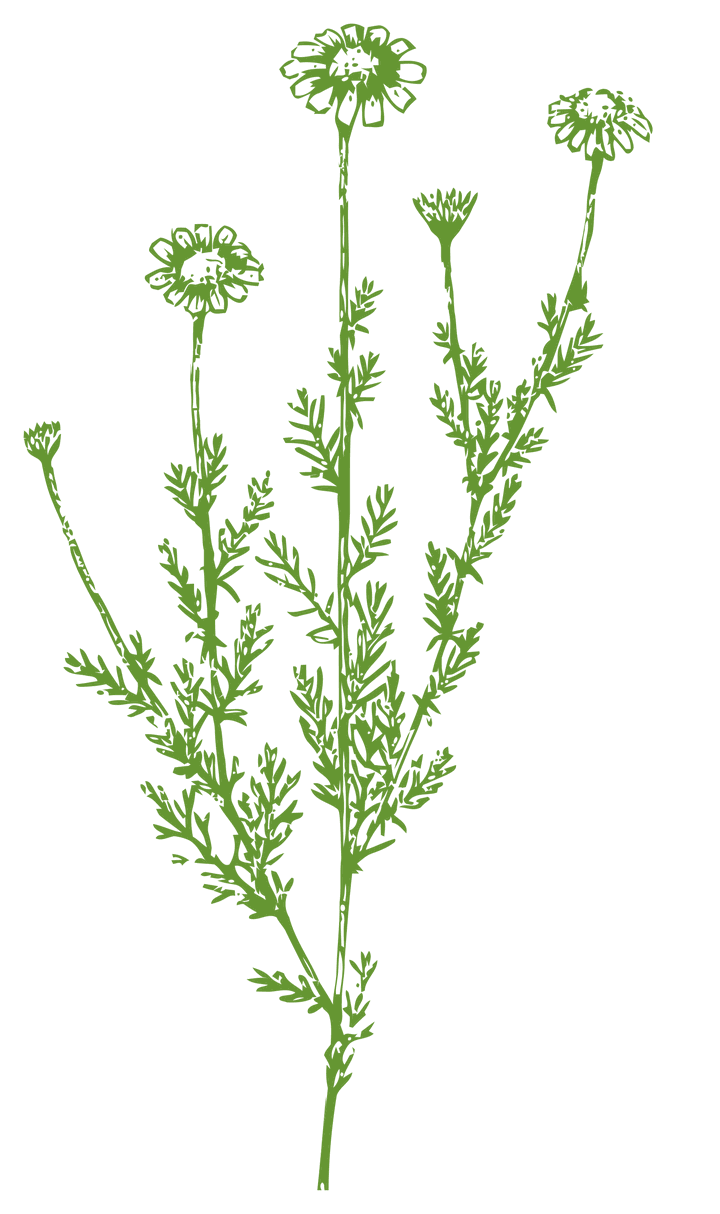
German chamomile is an upright annual, usually no more than about 2 feet tall, with finely divided leaves[2, 4]. Its small flower heads have a ring of white rays around a golden-yellow center, and the plant has an apple-like scent[2, 5, 6, 12]. It grows naturally from the islands of Macaronesia and North Africa across Europe and temperate Asia as far as Indochina[1, 2]. It has since spread far beyond that range and now grows wild in North and South America, including Peru, and in Australia and New Zealand[1].
Chamomile is one of the oldest herbs known[7]. It was described in ancient writings and was an important herb in ancient China, Egypt, Greece and Rome[3, 4]. The ancient Greek author Dioscorides mentioned it, and it has held its place in European herbal tradition ever since, from the great German herbals of Hieronymus Bock (1539) and Leonhard Fuchs (1543) to the present day[5, 13]. The Greek name passed into Latin as chamomilla[6], and when Carl Linnaeus named the species in 1753, he kept it: Matricaria chamomilla[1, 2]. Many books still use the later names Matricaria recutita and Chamomilla recutita, which botanists now regard as names for the same plant[1, 3].
Chamomile tea, made by steeping the dried flower heads in hot water, is the most popular way to enjoy the plant, and more than a million cups are drunk every day[2, 7]. In Spanish-speaking countries the same cup goes by the name manzanilla[8, 10].
Traditional uses
Chamomile has been tested in a number of small clinical studies in people[3, 4], and its tradition as a gentle tea is one of the oldest in the world[3, 7].
A relaxing cup
Chamomile tea has long been taken to help people unwind. Chamomile helps you relax.*[3, 4]
Digestive comfort
Chamomile tea is a classic of European tradition for the stomach and digestion. Chamomile supports digestive comfort.*[4, 13]
A bedtime tradition
A cup of chamomile at bedtime is a custom old enough to appear in a 1902 children's book[11]. For occasional sleeplessness.*[4, 7]
Plant compounds
Chamomile flower heads contain an essential oil rich in α-bisabolol and bisabolol oxides, along with chamazulene, the compound that makes the distilled oil blue; it forms during steam distillation from matricin, a compound in the flowers[4, 5]. The flowers also contain flavonoids, notably apigenin, together with luteolin[4, 5, 7], and coumarins such as herniarin and umbelliferone[5].
Precautions
- Not for use if you are allergic to chamomile or to other plants of the daisy family (Asteraceae), such as ragweed[3, 4, 13].
- If you are pregnant or breastfeeding, talk to your healthcare practitioner before use[3, 13].
- If you take medication, especially blood thinners, talk to your healthcare practitioner before use[3, 4].
Where our chamomile comes from
Our chamomile is wild-harvested. Every batch is tested for heavy metals, mold, yeast and pathogens.
- Wild-harvested
- South America
- Tested every batch
Raintree products with chamomile
Chamomile is also an ingredient in these Raintree products
Frequently asked questions
What is chamomile?
Chamomile is Matricaria chamomilla, a small, apple-scented annual of the daisy family. Its dried flower heads are best known as chamomile tea.
Is German chamomile the same as Roman chamomile?
No. They are two different plants of the daisy family. German chamomile (Matricaria chamomilla) is an annual, and it is the chamomile in Raintree products. Roman or English chamomile (Chamaemelum nobile) is a perennial.
What does chamomile smell like?
The flowers have an apple-like scent. That scent gave the plant its Greek name, "earth apple," and its Spanish name, manzanilla, "little apple."
How is chamomile tea traditionally made?
The dried flower heads are steeped in freshly boiled water, strained and drunk warm.
Which part of chamomile does Raintree use?
Traditionally, the dried flower heads are the part used. At Raintree, chamomile goes into our Calm Support and Mood Support formulas.
Where does chamomile grow?
Chamomile is native from the Atlantic islands off northwest Africa and North Africa across Europe and temperate Asia to Indochina.
References
- Royal Botanic Gardens, Kew. Plants of the World Online: Matricaria chamomilla L. powo.science.kew.org
- North Carolina State University Extension. Matricaria chamomilla (German chamomile). North Carolina Extension Gardener Plant Toolbox. plants.ces.ncsu.edu
- National Center for Complementary and Integrative Health (NCCIH). Chamomile. nccih.nih.gov. Updated November 2024.
- Drugs.com. Chamomile. The Review of Natural Products (professional monograph). drugs.com/npp/chamomile.html
- European Medicines Agency, Committee on Herbal Medicinal Products. Assessment report on Matricaria recutita L., flos and Matricaria recutita L., aetheroleum. EMA/HMPC/55837/2011. 7 July 2015. ema.europa.eu
- Harper D. Chamomile. Online Etymology Dictionary. etymonline.com
- Srivastava JK, Shankar E, Gupta S. Chamomile: a herbal medicine of the past with bright future. Molecular Medicine Reports. 2010;3(6):895–901. doi:10.3892/mmr.2010.377
- Real Academia Española. Manzanilla. Diccionario de la lengua española. dle.rae.es
- Merriam-Webster Dictionary. Manzanilla. merriam-webster.com
- GBIF Secretariat. Matricaria chamomilla L.: vernacular names (GRIN Taxonomy, Catalogue of Life, Flora e Funga do Brasil, Info Flora and other checklists). gbif.org
- Potter B. The Tale of Peter Rabbit. London: Frederick Warne & Co.; 1902. Project Gutenberg eBook #14838. gutenberg.org
- Encyclopaedia Britannica. Chamomile. britannica.com
- European Medicines Agency, Committee on Herbal Medicinal Products. European Union herbal monograph on Matricaria recutita L., flos. EMA/HMPC/55843/2011. 2015. ema.europa.eu