

 USD
USD


Did you know?
Articulatus is Latin for "jointed", and the plant's English name, jointed flatsedge, carries the same idea[1, 6].
Piri piri is a close cousin of papyrus (Cyperus papyrus), the sedge that ancient Egyptians made into writing material[3, 7].
Brazil's name for it, priprioca, comes from a legend: piripiri-oca, "the house of Piripiri", a warrior whose fragrance lived on in the plant[8].
In the Peruvian Amazon, piri piri is also the name for a whole group of garden sedges. Matsigenka hunters grow dozens of varieties, each one prized for success with a particular game animal[9].
Dried piri piri rhizomes are tucked among clothes to scent them, and burned in rooms as incense and to keep mosquitoes away[1, 2].
Its tough stems are woven into mats, and the rhizome is used to flavor food[1, 2].
Origins and history
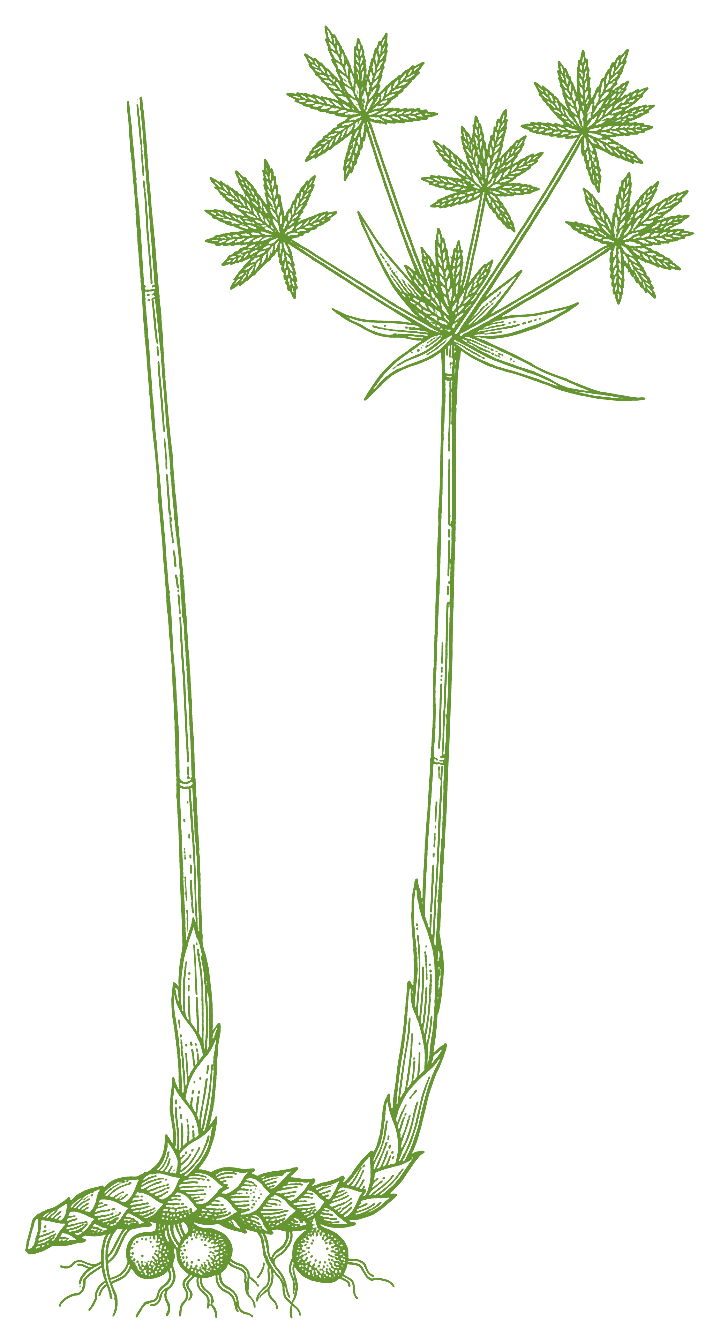
Piri piri is a perennial sedge that grows to about 6 feet tall in shallow water and wet ground: ponds, marshes, flooded land and the edges of rivers and lakes[1, 2]. Its round, hollow stems rise from a thick, creeping rhizome, and it is the rhizome that carries the plant's fragrance[1, 2]. Like papyrus, it belongs to Cyperus, a large genus of sedges[3, 7].
Its names follow it around the world. Carl Linnaeus named it Cyperus articulatus in 1753[4]. In the Spanish-speaking Amazon it is piri piri or piripiri, and a list of useful plants of Ecuador records several local variants of the name[6]. In Brazil it is priprioca[1, 5]; in English, jointed flatsedge or guinea rush; in French, souchet articulé[6].
Brazil's name has a story of its own. A legend recorded in 1926 by the researcher Antônio Brandão de Amorim tells of Piripiri, a warrior whose sweet fragrance charmed the young women of his village. One full-moon night, on the advice of her father, a shaman, a young woman wrapped his feet in her long hair while he slept. By morning Piripiri had vanished, and where he had lain grew a fragrant sedge. People called it piripiri-oca, "the house of Piripiri", and women began to bathe in it and rinse their hair with its grated roots[8]. The name became priprioca, and in the Amazon the rhizome still goes into perfumed baths and homemade perfumes[5].
People put nearly every part of it to use. The essential oil of the rhizome goes into perfumery and cosmetics, and the dried rhizomes are used to scent clothes and rooms[1, 2]. The rhizome also flavors food, and the tough stems are woven into mats[1, 2]. Along riverbanks, the plant helps hold the soil in place[1, 2].
Traditional uses
Clinical studies in people are still few, but its traditional use is rich: people have long valued the rhizome for its fragrance and as a gentle aid to the stomach.
A fragrant rhizome
The rhizome's essential oil is used in perfumes and cosmetics, dried rhizomes scent clothes and rooms, and in the Amazon the rhizome goes into perfumed baths.[1, 2, 5]
Digestive comfort
Indigenous peoples of the Amazon have long used the rhizome for the stomach and digestion, and it is recorded as a traditional aid to digestion. Piri piri supports digestive comfort.*[5, 10]
A calm mood
The rhizome is recorded in folk tradition as a calming herb. Piri piri supports a calm, relaxed mood.*[10]
Plant compounds
The rhizome holds a fragrant essential oil[1, 2]. Its main compounds include mustakone, cyclocolorenone and alpha-copaene[5].
Precautions
- Not for use during pregnancy or breastfeeding, or when trying to conceive.
- If you take medication, talk to your healthcare practitioner before use.
Where our piri piri comes from
Our piri piri rhizome is wild-harvested. Every batch is tested for heavy metals, mold, yeast and pathogens.
- Wild-harvested
- South America
- Tested every batch
Raintree products with piri piri
 CapsulesPiri Piri CapsulesPiri piri rhizome, 500 mg per capsule, nothing added.Out of stockView product →
PowderPiri piri powderOut of stockView product →
CapsulesPiri Piri CapsulesPiri piri rhizome, 500 mg per capsule, nothing added.Out of stockView product →
PowderPiri piri powderOut of stockView product →
 ExtractPiri piri extractOut of stockView product →
Piri piri is also an ingredient in these Raintree products

Frequently asked questions
Is piri piri the same as the piri-piri chili?
No. Piri-piri, also spelled peri-peri, is best known as a hot chili pepper and the spicy sauce made from it[11]. Raintree's piri piri is a different plant altogether: the fragrant rhizome of a sedge, Cyperus articulatus. It is a sedge, not a pepper.
What is piri piri called in English and Portuguese?
In English it is called jointed flatsedge or guinea rush. In Brazilian Portuguese it is priprioca.
What does piri piri smell like?
The rhizome is strongly fragrant. Its scent is valued by perfumers, and dried rhizomes are used to scent clothes and rooms.
Which part of piri piri does Raintree use?
The rhizome, the plant's fragrant underground stem, wild-harvested.
Where does piri piri grow?
In shallow water and wet ground throughout the tropics and subtropics: Central and South America including the Amazon, the Caribbean, the southern United States, Africa, southern Asia and northern Australia.
Is piri piri related to papyrus?
Yes. Both belong to the sedge genus Cyperus; papyrus is Cyperus papyrus.
References
- Plants For A Future (PFAF). Cyperus articulatus. pfaf.org
- Fern K. Useful Tropical Plants Database: Cyperus articulatus. tropical.theferns.info
- Royal Botanic Gardens, Kew. Plants of the World Online: Cyperus articulatus L. powo.science.kew.org
- International Plant Names Index (IPNI). Cyperus articulatus L., Species Plantarum 1: 44 (1753). ipni.org
- Ferreira JCC, Pereira AMN, Aranha ESP, Moraes CC, Ferreira BS, Sartoratto A, Goes GR, Moraes TMP, Moraes WP. Cyperus articulatus: anti-inflammatory and antinociceptive activity of a medicinal plant from the Amazon. Journal of Ethnopharmacology. 2025;337:118947. doi:10.1016/j.jep.2024.118947
- Global Biodiversity Information Facility (GBIF). Cyperus articulatus L.: vernacular names. gbif.org
- Encyclopaedia Britannica. Papyrus. britannica.com
- A lenda do índio Piripiri. Folha do Meio Ambiente (Filatelia & Meio Ambiente). 24 November 2004. folhadomeio.com
- Shepard GH Jr. The hunter in the rye: ergot, sedges and hunting magic in the Peruvian Amazon. Notes from the Ethnoground (blog). October 2011. ethnoground.blogspot.com
- US Department of Agriculture, Agricultural Research Service. Dr. Duke's Phytochemical and Ethnobotanical Databases: Cyperus articulatus, ethnobotanical uses. phytochem.nal.usda.gov
- Oxford Learner's Dictionaries. Piri-piri. oxfordlearnersdictionaries.com