

 USD
USD


Did you know?
Damiana is a cousin of the passionflower. Botanists now place it in the passionflower family, Passifloraceae, although older books give it a family of its own, Turneraceae[1, 4, 5].
Its old botanical name, Turnera aphrodisiaca, borrows from Aphrodite, the Greek goddess of love. It was published in 1876, while damiana was new to American pharmacy, and botanists now count it as the same plant as Turnera diffusa[1, 2, 6].
In Mexico it is often called hierba de la pastora, "the shepherdess's herb"[3, 4].
Two of its Mexican names compare it to oregano: oreganillo, "little oregano", and orégano cimarrón, "wild oregano"[2].
In Baja California Sur, damiana liqueur is often sold in a bottle shaped like a female figure, and in Los Cabos damiana margaritas are a local favorite[7].
Damiana is a plant of dry country, growing mainly in the seasonally dry tropics and in the arid and semi-arid regions of Mexico[1, 4].
Origins and history
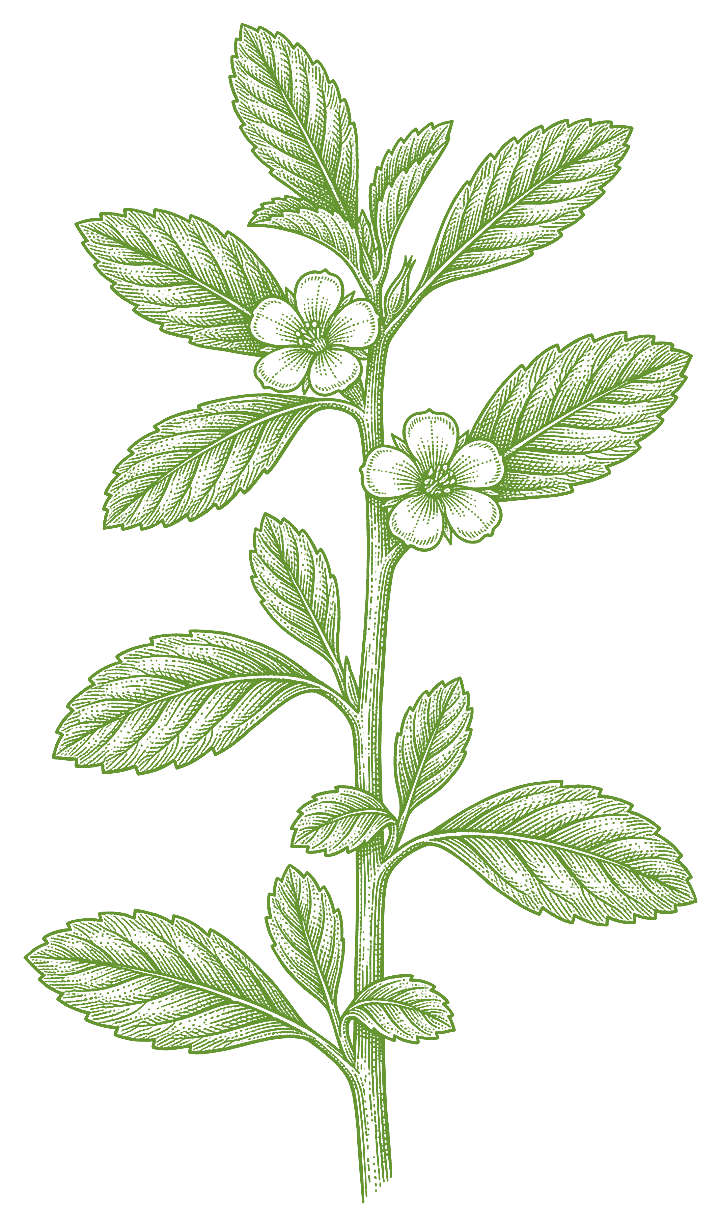
Damiana is a much-branched shrub, usually no taller than about 6 feet (2 m), with slightly reddish stems, small toothed leaves mostly under an inch long, and bright yellow flowers[3, 4, 5, 6]. The leaves are fragrant, with a scent that an 1898 American pharmacy text likened to lemon balm[6]. It grows from southern Texas through much of Mexico and Central America to the Caribbean islands and eastern Brazil, most often in dry places[1, 4, 5].
Among the Maya, damiana was valued as a tonic to restore strength[3]. The plant reached a wider world in the 1870s. In 1874 an American doctor introduced it to US pharmacy with leaves supplied by the United States consul at Cabo San Lucas, Mexico[6]. In 1876 a paper in the Virginia Medical Monthly named it Turnera aphrodisiaca, a name that reflects the reputation the plant brought with it from Mexico[1, 2, 3]. Botanists later concluded that it was the same plant already named Turnera diffusa, and that is the name used today[1, 2]. Damiana was in the first edition of the US National Formulary in 1888, and the leaf stayed in it until 1947[3].
In Mexico damiana is still gathered mostly from wild plants[4]. The dried leaves are sold for tea and give damiana liqueur its flavor[4, 7]. The liqueur is credited to the Guaycura, the original people of much of Baja California Sur, and a La Paz merchant, Antonio Ruffo Santa Cruz, was the first to sell it commercially, in the 1860s. Many families in the region still make it at home from the leaves, honey, sugar, water and a spirit[7].
Traditional uses
Damiana has been studied in people mainly as one herb in multi-herb blends, but its traditional use is long and consistent: in Mexico it is a leaf tea taken for vitality and for intimacy.
A fragrant leaf tea
The dried leaves are steeped in hot water and drunk as a tea.[4]
Energy and vitality
The Maya valued damiana as a restorative tonic, and nineteenth-century American pharmacy described it as a tonic for the whole body. Damiana supports energy and vitality.*[3, 6]
Healthy libido
This is damiana's best-known traditional role in Mexico. Damiana supports healthy libido.*[3, 4]
Plant compounds
Damiana leaf contains flavonoids, including apigenin and acacetin, along with arbutin and a compound named after the plant, damianin[3, 4]. Its fragrance comes from an essential oil that makes up about 0.5 to 1% of the dried leaf and is rich in 1,8-cineole, pinenes and thymol[3]. The leaf also contains cyanogenic glycosides[3, 4].
Precautions
Where our damiana comes from
Our damiana leaf is wild-harvested. Every batch is tested for heavy metals, mold, yeast and pathogens.
- Wild-harvested
- South America
- Tested every batch
Raintree products with damiana

Damiana is also an ingredient in these Raintree products
Frequently asked questions
What is damiana?
Damiana is Turnera diffusa, a small, fragrant shrub of the passionflower family with yellow flowers. Its leaves have a long tradition in Mexico as a tea.
Is damiana from the Amazon?
No. Damiana is native to southern Texas, Mexico, Central America, the Caribbean and eastern Brazil, and it grows mainly in dry country, far from the Amazon rainforest.
Why was damiana called Turnera aphrodisiaca?
The name was published in 1876, when damiana was new to American pharmacy, and it borrows from Aphrodite, the Greek goddess of love, reflecting the plant's old reputation in Mexico. Botanists now use the older name, Turnera diffusa.
What does damiana smell like?
The leaves are fragrant. An 1898 American pharmacy text compared their scent to lemon balm, and some Mexican names for the plant, such as oreganillo, compare it to oregano.
Which part of damiana does Raintree use?
We use the leaf, wild-harvested.
What is damiana liqueur?
A sweet herbal liqueur from Baja California Sur, made with damiana leaves, honey and sugar. It is often sold in a bottle shaped like a female figure, and in Los Cabos it is a favorite addition to margaritas.
References
- Royal Botanic Gardens, Kew. Plants of the World Online: Turnera diffusa Willd. ex Schult. powo.science.kew.org
- GBIF Secretariat. Turnera diffusa Willd. ex Schult. and Turnera aphrodisiaca Ward. GBIF Backbone Taxonomy and checklist datasets (names, synonyms, vernacular names). gbif.org
- Drugs.com. Damiana. The Review of Natural Products (professional monograph). drugs.com/npp/damiana.html. Updated 22 June 2026.
- García-Castillo D, Herrera-Camacho J, Martínez-Palacios A. Damiana Turnera diffusa (Passifloraceae): la planta de la pasión. Bioagrociencias. 2025;18(1):83–88. doi:10.56369/BAC.6216
- Lady Bird Johnson Wildflower Center, University of Texas at Austin. Turnera diffusa (damiana). Native Plant Database. wildflower.org
- Felter HW, Lloyd JU. Turnera (Damiana). In: King's American Dispensatory. Cincinnati: Ohio Valley Co.; 1898. Online text: henriettes-herb.com
- Sands C. Baja California's secret ingredient for the perfect margarita. Mexico News Daily. 2 March 2024. mexiconewsdaily.com
- RxList. Damiana: health benefits, side effects, uses, dose and precautions. rxlist.com/damiana/supplements.htm. Accessed 29 Sep 2026.